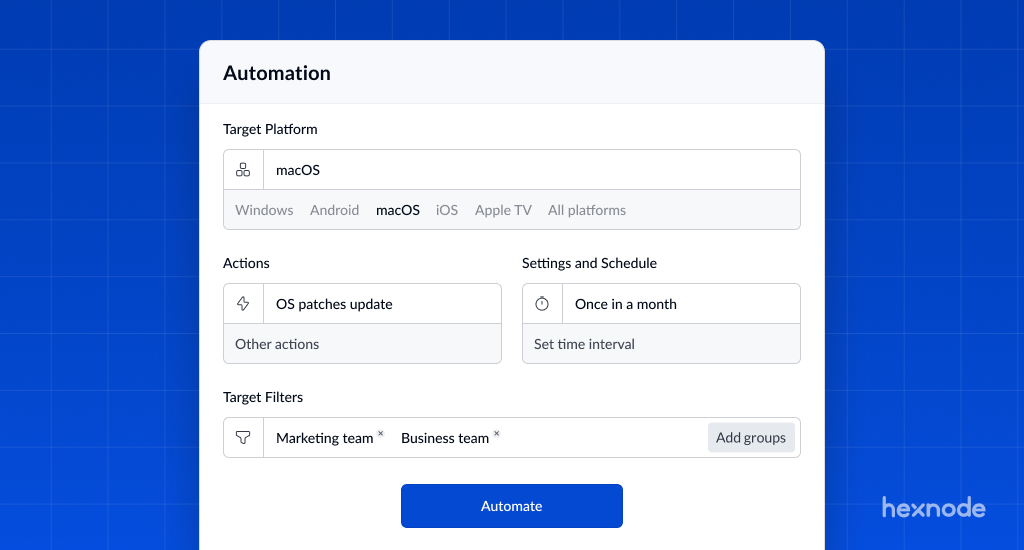
AI-assisted patch remediation helps IT teams prioritize, investigate, and remediate missing software updates more efficiently by providing intelligent recommendations instead of relying solely on manual analysis. When combined with human oversight and well-defined governance, it can reduce remediation time, improve patch compliance, and strengthen endpoint security. Solutions like Hexnode Genie further simplify these workflows by enabling administrators to retrieve insights and troubleshoot managed devices using natural language.
Keeping enterprise devices fully patched has become increasingly challenging as organizations manage a growing mix of operating systems, third-party applications, and rapidly disclosed security vulnerabilities. Modern IT environments often span office, remote, hybrid, and bring-your-own-device (BYOD) scenarios, making it harder to maintain consistent patch compliance across every endpoint.
Traditional patch remediation typically relies on administrators to identify missing updates, assess their potential impact, prioritize affected devices, and coordinate deployments. As device fleets grow, these manual processes become more time-consuming and difficult to scale. Delays in remediating critical vulnerabilities can extend the window during which attackers may exploit known security flaws, increasing organizational risk.
AI-assisted patch remediation is the use of artificial intelligence to help IT teams identify, prioritize, and remediate missing software updates more efficiently. Rather than replacing administrators, AI supports decision-making by analyzing information from managed endpoints, such as patch status, device characteristics, vulnerability severity, and other relevant context, to recommend appropriate remediation actions. The goal is to reduce manual effort, improve prioritization, and accelerate the remediation of security risks while keeping administrators in control.
Unlike traditional patch management, which often requires teams to manually review large numbers of missing updates, AI can help surface the most important remediation tasks first. By considering multiple factors together instead of relying on a single criterion, AI can help administrators focus on updates that present the greatest operational or security risk.
High-risk remediation decisions, however, should still involve human oversight. Business-critical systems, compatibility concerns, regulatory requirements, and maintenance windows often require administrative review before updates are deployed. AI serves as a decision-support tool rather than an autonomous replacement for established IT change management processes.
AI Assistance vs Traditional Automation
Traditional automation follows predefined rules. For example, a workflow might deploy a specific update whenever certain conditions are met. While effective for repetitive tasks, these rule-based processes generally cannot adapt to changing conditions unless administrators modify the rules.
AI assistance adds another layer of intelligence by evaluating multiple contextual signals before recommending actions. Instead of simply identifying missing patches, it can help prioritize remediation based on factors such as vulnerability severity, device importance, and overall exposure. As AI models evolve and are refined over time, they may improve the relevance and consistency of their recommendations, enabling IT teams to make faster, more informed patch management decisions while retaining full administrative control.
Where AI Adds Value Throughout the Patch Remediation Process
AI can support IT teams at every stage of the patch remediation lifecycle, helping them work more efficiently without removing the need for administrative oversight. Rather than simply automating repetitive tasks, AI helps organize information, prioritize actions, and surface insights that would otherwise require significant manual effort.
Identifying Missing Patches Faster
The first step is understanding which devices need attention. AI can analyze continuous endpoint inventory data, detect missing operating system and third-party application updates, and correlate vulnerability information with affected devices. This enables administrators to identify remediation needs more quickly than manually reviewing individual systems.
Prioritizing What Actually Matters
Not every missing patch requires the same level of urgency. AI can evaluate multiple factors—such as vulnerability severity, device criticality, business impact, and potential exposure—to help prioritize remediation efforts. This risk-based approach enables IT teams to address the most significant security gaps first instead of treating every missing update equally.
Recommending the Right Remediation Actions
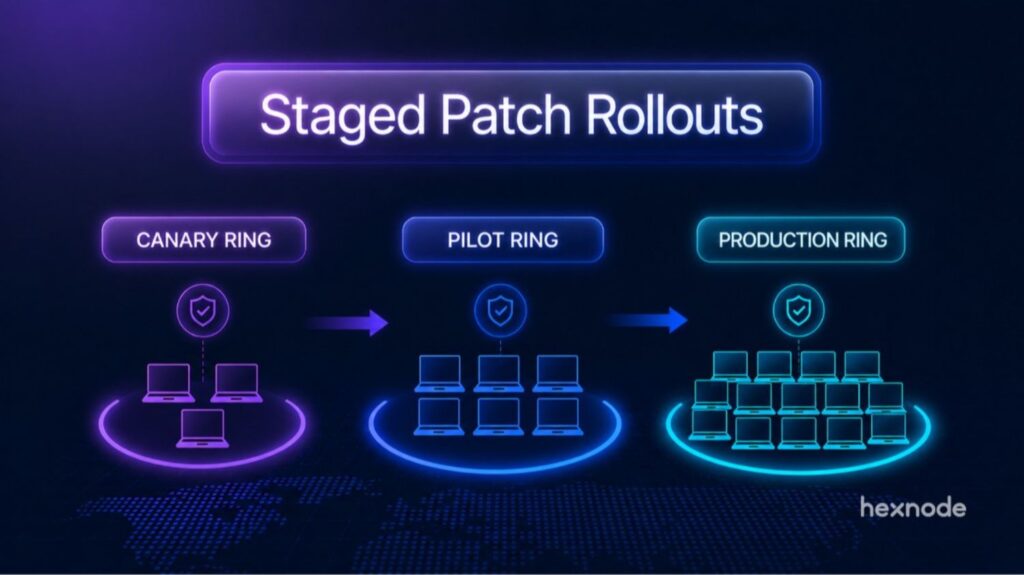
AI can also assist with planning remediation by recommending suitable deployment windows, highlighting potential software dependencies, and suggesting phased rollout strategies where appropriate. These insights help reduce manual analysis and support more informed deployment decisions, particularly in large or distributed environments.
Monitoring Remediation Outcomes
After updates are deployed, AI can help identify unsuccessful installations, validate patch compliance, and flag devices that require additional investigation or follow-up. This continuous visibility helps ensure remediation efforts are completed successfully while reducing the time administrators spend tracking patch status across large fleets of devices.
Modern AI-powered endpoint management platforms are increasingly incorporating capabilities like these to help IT teams make faster, more informed patch remediation decisions while maintaining human oversight.
IT Admin’s Guide to Patch Management with Hexnode
Simplify patch management with Hexnode by automating updates, improving visibility, and securing endpoints.
Benefits of AI-Assisted Patch Remediation for IT Teams
Reduces Mean Time to Remediate (MTTR): AI helps IT teams identify and prioritize critical patching tasks faster, enabling quicker remediation of security vulnerabilities.
Minimizes Manual Triage: By automatically analyzing endpoint and vulnerability data, AI reduces the time administrators spend reviewing missing patches and deciding what to address first.
Improves Remediation Consistency: AI-assisted recommendations help standardize patch prioritization and remediation workflows across large and distributed device fleets.
Strengthens Compliance Readiness: Faster identification of missing updates and improved patch visibility make it easier for organizations to maintain security baselines and demonstrate patch compliance.
Accelerates Response to New Vulnerabilities: AI can quickly correlate newly disclosed vulnerabilities with affected devices, helping IT teams prioritize remediation before known flaws can be exploited.
Optimizes IT Resources: By reducing repetitive analysis and administrative overhead, AI enables IT teams to spend more time on strategic initiatives and complex security challenges rather than routine patch management tasks.
Best Practices for Using AI in Patch Remediation
AI can make patch remediation faster and more efficient, but it delivers the best results when combined with strong governance and established IT processes. Organizations should treat AI as a decision-support tool rather than an autonomous system, especially when patching devices that support critical business operations.
To adopt AI-assisted patch remediation responsibly, consider these best practices:
Keep humans involved in critical decisions: Require administrator approval before deploying patches to business-critical systems or high-risk environments.
Validate AI recommendations: Review suggested remediation actions to ensure they align with organizational policies, maintenance schedules, and operational priorities.
Test updates before broad deployment: Roll out patches to a pilot group or staged environment first to identify compatibility issues before deploying them across the organization.
Maintain rollback plans: Have a documented recovery process in place so updates can be reversed quickly if they introduce unexpected problems.
Review remediation policies regularly: As your IT environment evolves, update patching priorities, approval workflows, and deployment policies to reflect new risks and business requirements.
AI Should Assist, Not Replace IT Decision-Making
While AI can analyze large volumes of endpoint and vulnerability data far more quickly than humans, it cannot fully understand every business or operational consideration. Factors such as regulatory obligations, application compatibility, maintenance windows, and the importance of specific systems often require human judgment.
Rather than making patch decisions independently, AI should provide timely insights and recommendations that help administrators make faster, more informed choices. Combining AI-driven intelligence with human oversight enables organizations to improve patch remediation efficiency while maintaining security, compliance, and operational stability.
Accelerating Patch Remediation with Hexnode Genie
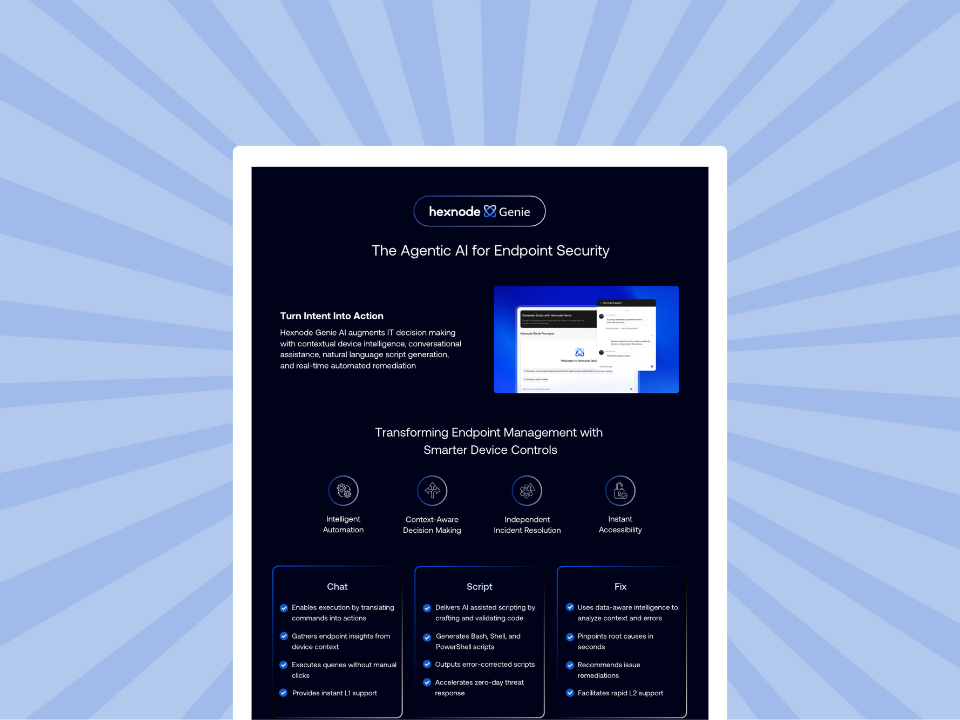
AI-assisted patch remediation is most effective when it helps administrators spend less time searching for information and more time resolving issues. Hexnode Genie brings this approach into endpoint management by providing an AI-powered conversational interface that simplifies everyday administrative tasks and troubleshooting. Rather than navigating multiple menus or manually filtering device data, administrators can interact with Genie using natural language to retrieve relevant information and accelerate remediation workflows.
For patch remediation, Hexnode Genie can help IT teams:
Surface patch and device insights through natural language queries, reducing the time spent navigating management consoles.
Retrieve information about managed devices more efficiently, helping administrators identify endpoints that require attention.
Provide contextual troubleshooting guidance by reviewing action history and error messages to help diagnose failed management actions and recommend remediation steps.
Generate scripts from natural language prompts to help automate remediation tasks when custom scripting is required, with support for reviewing and editing generated scripts before deployment.
Reduce administrative effort by enabling administrators to interact with devices and management data conversationally instead of relying solely on manual navigation and complex filtering.
By combining conversational AI, contextual troubleshooting, and AI-assisted script generation, Hexnode Genie helps streamline patch remediation workflows without removing administrators from the decision-making process. IT teams gain faster visibility into endpoint status, quicker access to actionable insights, and improved operational efficiency while maintaining control over approvals, deployments, and remediation activities. This balance between AI assistance and human oversight enables organizations to improve patch compliance and respond more effectively to endpoint management challenges.
Feature Resource
Hexnode Genie Info Sheet
Turn everyday IT tasks into instant actions with Hexnode Genie.
As enterprise environments continue to grow in size and complexity, patch remediation must become faster, smarter, and more adaptive. AI helps IT teams improve prioritization, reduce manual effort, and accelerate endpoint remediation. At the same time, administrators retain control over critical decisions.
Organizations should combine AI-assisted recommendations with strong governance, human oversight, and clearly defined patch management processes. This approach can help them reduce security risks and maintain compliance.
Looking ahead, effective endpoint remediation strategies will pair intelligent assistance with responsible automation. As a result, IT teams can strengthen security without sacrificing operational control.
Try Hexnode Free for 14 Days
Simplify patch remediation with AI-powered insights and keep every endpoint secure, compliant, and up to date with Hexnode.
How is AI patch remediation different from vulnerability management?
Although they are closely related, they serve different purposes. Vulnerability management focuses on discovering, assessing, and prioritizing security weaknesses across an organization’s environment. AI patch remediation focuses on helping IT teams remediate those vulnerabilities by intelligently prioritizing missing updates, recommending appropriate actions, and streamlining patch deployment workflows. Together, they help reduce overall security risk.
Can AI-assisted patch remediation help with third-party application updates?
Yes. Modern AI-assisted patch remediation solutions can support operating system updates as well as many third-party application updates, depending on the organization’s patch management platform. AI can help identify outdated software, prioritize applications based on risk, and recommend remediation actions to improve patch compliance across the endpoint environment.
Is AI patch management suitable for small and medium-sized businesses?
Absolutely. While large enterprises often manage thousands of endpoints, AI patch management can also benefit smaller organizations by reducing administrative workload and simplifying routine maintenance. IT teams with limited resources can use AI-assisted insights to improve remediation efficiency without significantly increasing operational overhead.
What metrics should organizations track to measure the success of AI-assisted patch remediation?
Beyond tracking Mean Time to Remediate (MTTR), organizations should monitor metrics such as patch compliance rates, the percentage of critical vulnerabilities remediated within policy timelines, remediation success rates, failed deployment rates, and the number of devices remaining non-compliant. These metrics provide a clearer picture of the effectiveness of an automated patch remediation strategy.
How does AI-assisted patch remediation support cyber resilience?
Effective AI-assisted patch remediation helps organizations recover more quickly from newly disclosed vulnerabilities by enabling faster identification, prioritization, and remediation of affected endpoints. When integrated into a broader endpoint remediation and security strategy, it can reduce the likelihood of prolonged exposure to known vulnerabilities and improve overall operational resilience.
I’m a technical content writer at Hexnode who loves simplifying tech. I break down complex ideas, remove the fluff, and help readers clearly understand our product for what it actually is: simple, reliable, and built to solve real problems.