Device as a Service (DaaS) simplifies how organizations acquire, deploy, and refresh hardware, but the device still requires ongoing management after delivery. UEM in Device as a Service provides the management layer for controlling devices throughout their active use.
Between deployment and retirement, IT teams still need to configure settings, manage applications and updates, enforce security policies, troubleshoot issues, maintain device visibility, and handle deprovisioning. Without a centralized approach, these activities can remain disconnected from the broader DaaS lifecycle.
UEM connects these digital management tasks while the DaaS model handles services such as physical logistics, repair, refurbishment, and disposal.
Where does the DaaS model start to strain?
DaaS becomes harder to manage as device volumes, users, locations, operating systems, replacements, and refresh cycles increase. Each addition creates more management events for IT.
Handling these events individually can replace the efficiency of DaaS with repetitive administrative work. The challenge is therefore not simply delivering devices but maintaining a repeatable management model after deployment.
DaaS operations are most vulnerable to friction when devices move between lifecycle stages. A device may pass from provider to employee, employee to support, replacement to reassignment, and eventually to retirement.
When these handoffs are disconnected, IT teams can face delayed provisioning, inconsistent configurations, limited inventory visibility, outdated devices, and incomplete offboarding. As fleets expand, managing these transitions consistently becomes essential to keeping the DaaS model scalable.
What changes when hundreds of devices become thousands?
At larger scales, manual processes become difficult to sustain:
Individual troubleshooting becomes harder across distributed fleets.
Spreadsheet tracking can leave device records fragmented or outdated.
One-off actions make consistent management difficult.
DaaS therefore depends on repeatable processes that can be applied consistently across device groups.
What role does UEM actually play in Device-as-a-Service?
UEM acts as the digital management layer in DaaS, supporting enrollment, configuration, applications, policies, updates, compliance, and remote administration, while the DaaS provider may handle services such as procurement, delivery, retrieval, refurbishment, and replacement depending on the agreement.
Lifecycle stage
What needs to happen
How UEM supports it
Initial deployment
Prepare devices for users
Enrollment, configuration, application and policy deployment
Active use
Keep devices managed
Device visibility, configuration changes and remote administration
Maintenance
Keep software and settings current
Application and OS update management on supported platforms
Compliance
Track whether devices meet requirements
Compliance monitoring and policy management
Support
Resolve device issues
Device information and supported remote management actions
User transition
Prepare a device for reassignment
Deprovisioning and supported wipe actions
Refresh or retirement
Remove the device from active management
Supported wipe and device-management removal processes
Where does UEM take control?
Unified Endpoint Management becomes relevant when a device needs to be enrolled, configured, monitored, updated, secured, or remotely managed. Its role continues until the endpoint leaves management.
Why does management continue after provisioning?
Provisioning is only the beginning. Devices require continuous management as operational requirements change:
Applications need deployment, updates, or removal
Configurations and policies change with organizational requirements
UEM keeps these activities manageable throughout the device’s active service period.
What happens when a device changes hands?
Employee moves, replacements, refreshes, and offboarding introduce additional management tasks:
Remove user-specific applications and configurations.
Perform supported wipe or deprovisioning actions.
Update the device’s assignment and management state.
Prepare it for reassignment, refresh, or retirement.
These actions connect endpoint administration with the broader DaaS lifecycle.
How Device as a Service (DaaS) helps mitigate the risks of BYOD
Manage multi-OS DaaS fleets through centralized, scalable device lifecycle workflows.
UEM turns DaaS from individual device management into repeatable operations
UEM helps DaaS teams move from managing devices individually to applying repeatable processes across device groups. This becomes increasingly important as fleets grow and lifecycle events multiply.
Key areas include:
Standardized configurations for similar device groups.
Centralized actions instead of device-by-device administration.
Automation for recurring management tasks.
Reporting and visibility across managed devices.
Standardization does not mean treating every OS the same
Centralized management does not make every platform identical. DaaS workflows must account for differences in:
Enrollment methods
Configuration and restriction options
Application deployment
OS update controls
Available remote actions
A scalable DaaS model standardizes the management process while respecting platform-specific capabilities.
Where does automation matter most?
Automation is most useful for frequent, predictable tasks such as:
Deploying applications and configurations
Scheduling recurring administrative actions
Performing routine maintenance tasks
Applying actions to defined device groups
Exceptions, failures, and unusual device states still require administrator review.
Can your DaaS workflow manage the same device twice?
A useful test of a DaaS workflow is whether a returned device can move efficiently to its next user.
Consider a laptop issued to Employee A. IT enrolls and configures it, manages it during active use, and processes it when the employee leaves. The device can then be retrieved, wiped and reconditioned before being prepared for Employee B. Re-enrollment requirements depend on the platform and original enrollment method.
Centralized actions and automation for recurring tasks.
Reporting and visibility throughout the managed lifecycle.
Where does Hexnode fit into the DaaS management layer?
Hexnode UEM supports DaaS operations by bringing device management, automation, reporting, and lifecycle actions into a centralized management environment. Relevant capabilities include:
Multi-OS management: Manage supported device platforms from a centralized console while applying platform-specific enrollment and management controls.
Hexnode UEM Automations: Build repeatable workflows using supported triggers, target filters, schedules, and multiple management actions.
Hexnode Genie: With Hexnode Genie, generate and refine custom scripts from natural-language prompts, helping administrators create scripts for supported device-management tasks. Scripts should be reviewed and tested before deployment.
Reports and analytics: Use built-in, custom, and scheduled reports to monitor device, enrollment, compliance, application, policy, and other management data.
Refresh and renewal: Use supported device-wipe actions when preparing endpoints for reassignment or retirement. Re-enrollment after a wipe depends on the platform and enrollment method.
Hexnode UEM MSP: DaaS providers can manage multiple customer UEM instances from a single MSP portal while keeping each customer environment separate.
Featured resource
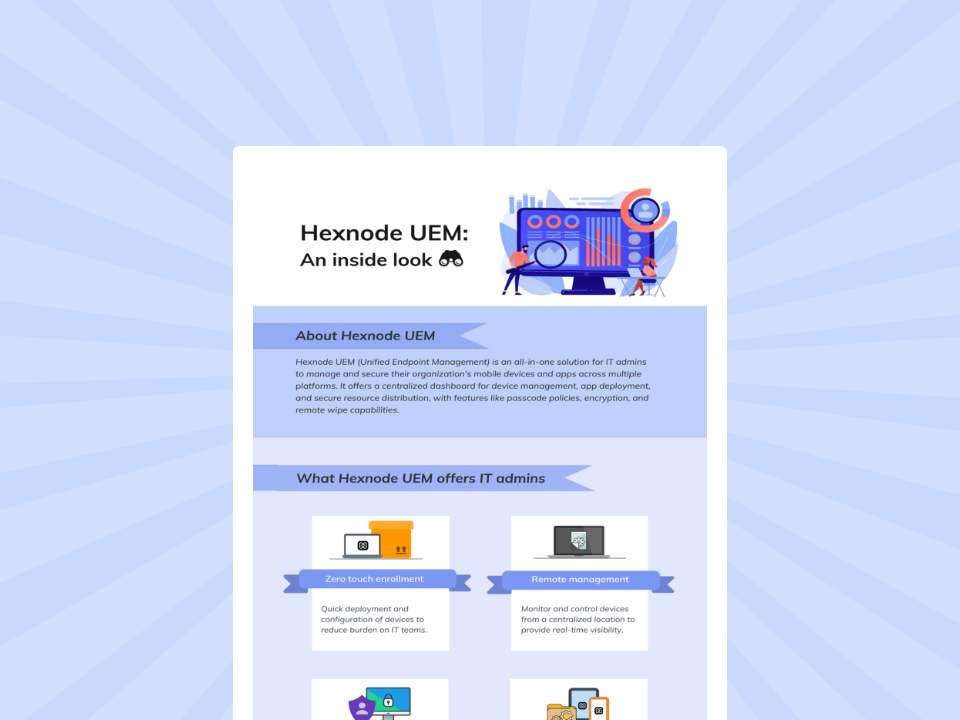
Hexnode UEM: An inside look
Learn how Hexnode UEM centralizes cross-platform device management, app deployment, security, and remote administration efficiently.
No. UEM provides centralized endpoint management, while a DaaS provider can bundle devices with services such as procurement, deployment, support, management, retrieval, refurbishment, and replacement. The exact division of responsibilities depends on the DaaS agreement. The two serve complementary roles within the device lifecycle.
Can the same UEM workflow be used across every operating system?
Not always. Enrollment methods, application deployment, update controls, restrictions, and remote actions can differ by operating system. DaaS teams should standardize their overall management processes while maintaining platform-specific workflows where required.
How does UEM help when DaaS devices are reassigned to new users?
UEM can support reassignment through actions such as removing configurations, wiping supported devices, updating assignments, and preparing endpoints for renewed management. Re-enrollment requirements after a wipe depend on the device platform and enrollment method.
DaaS needs a management layer, not just a device supply model
DaaS can simplify how organizations acquire, deploy, refresh, and retire devices, but those endpoints still require continuous management throughout their working life. UEM provides the digital management layer needed to maintain control after devices are deployed.
Together, DaaS and UEM address different parts of the device lifecycle: DaaS supports the broader service model, while UEM centralizes ongoing endpoint administration. Organizations building a DaaS strategy can explore Hexnode UEM to bring these management requirements into a more consistent, scalable workflow.
Strengthen DaaS with centralized UEM
Simplify device lifecycle management. Start your free trial.
A storyteller for practical people. Breaks down complicated topics into steps, trade-offs, and clear next actions—without the buzzword fog. Known to replace fluff with facts, sharpen the message, and keep things readable—politely.