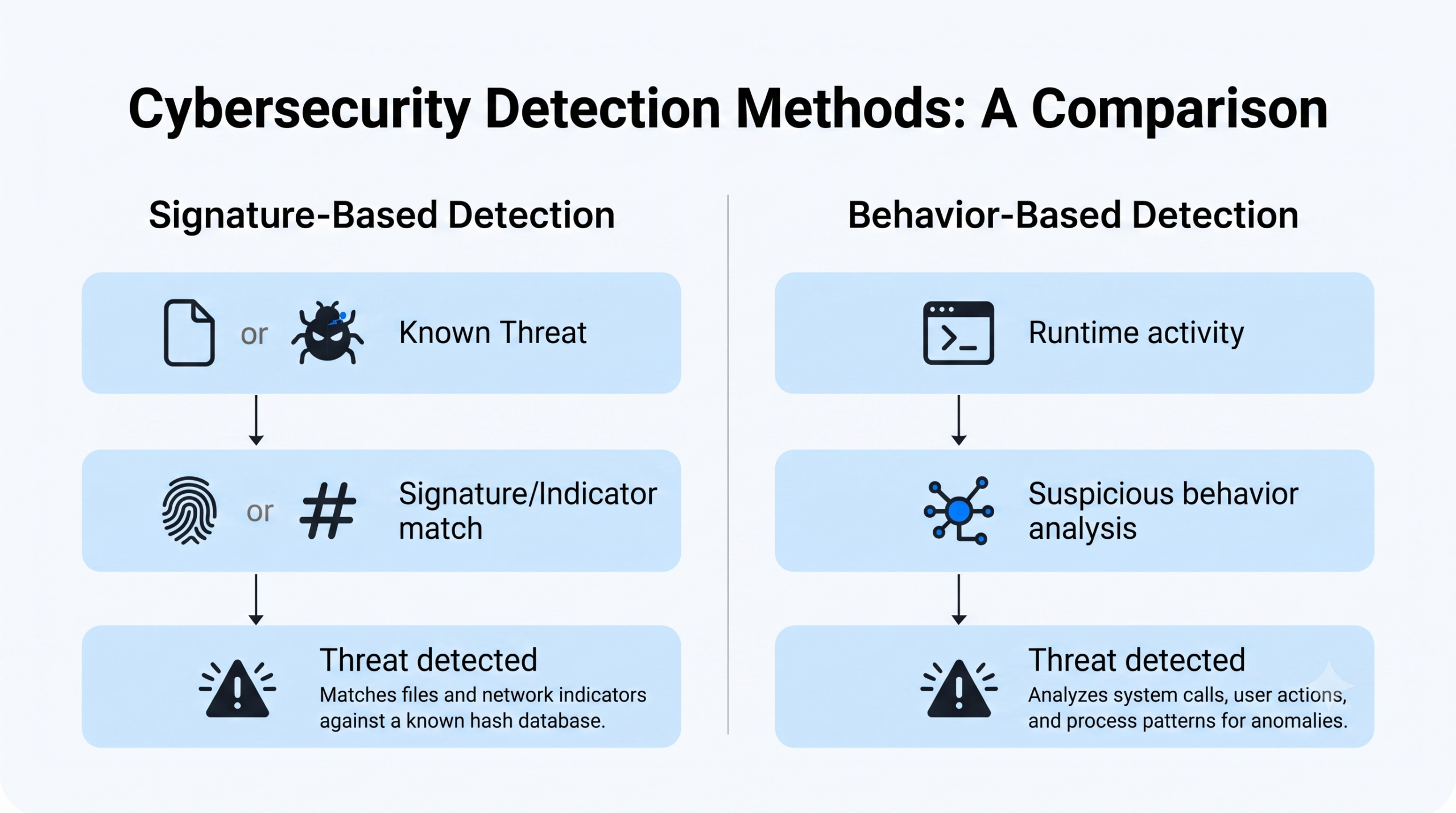
Signature-based detection efficiently identifies known threats using established indicators, but can miss new or evasive attacks without a matching signature. Behavior-based detection analyzes runtime activity to uncover suspicious patterns, extending coverage to novel, fileless, and polymorphic threats, though it requires more context and tuning. For most enterprises, the goal is not to choose one method over the other, but to combine complementary detection approaches and align coverage with the organization’s actual threat profile.
“Detection” is often treated as a single capability in security product comparisons, but the underlying method can vary significantly. One platform may rely on static signatures. Another analyzes runtime behavior, execution patterns, and suspicious process relationships. Some tools combine both approaches, yet marketing material does not always make that distinction clear.
For IT and security teams, that difference directly affects threat coverage. Signature-based detection is generally strongest when a threat has already been identified and a reliable pattern, hash, rule, or indicator exists to recognize it. Behavior-based detection instead looks for actions or sequences that suggest malicious intent, which can help identify threats that do not yet match a known signature.
Neither approach should be evaluated simply as “better detection.” These approaches address distinct segments of the threat landscape. However, they introduce unique trade-offs in latency, false positives, and intelligence dependencies.
The more useful question for enterprise buyers is therefore not whether a product offers detection, but how it detects threats. Comparing signature and behavior-based detection reveals threat coverage. It also highlights where security blind spots remain.
What Happens When Teams Don’t Understand This Distinction
The biggest risk is a false sense of coverage. Signature-based detection stops known malware effectively. However, it misses novel threats lacking established signatures.
That gap becomes especially important with threats such as fileless malware, polymorphic malware, and zero-day exploits. Fileless attacks may abuse legitimate system tools and execute primarily in memory. Polymorphic malware constantly alters its identifiable code. Meanwhile, zero-day vulnerabilities lack established signatures during initial exploitation.
The problem is not simply that one malicious file goes undetected. Organizations often overestimate endpoint detection capabilities. This misunderstanding fundamentally weakens their broader security posture.
The operational cost often becomes visible only after an incident. Investigations often reveal the affected endpoint was technically protected. However, deployed controls lacked the ability to recognize the specific attack behavior. Unrecognized attacks lengthen dwell time, broaden investigation scope, and complicate containment. Ultimately, this raises difficult questions regarding undetected threat vectors.
What Is Signature-Based Detection?
Signature-based detection compares observed activity against predefined threat patterns. It identifies known risks using static indicators like hashes and byte sequences. When the inspected object matches a known signature, the security tool can flag, block, or quarantine it.
Its main advantage is efficiency. Signature matching is typically fast, computationally lightweight, and precise when dealing with malware that has already been catalogued. Because the detection logic is based on a known malicious pattern, it can also produce relatively few false positives compared with techniques that infer malicious intent from unusual behavior.
This makes signature-based detection effective for stopping established malware families and previously observed attack artifacts at scale. Security vendors can continuously update signature databases as new threats are analyzed, allowing endpoints to recognize those threats in subsequent encounters.
The limitation is that the model is fundamentally reactive.Generating a reliable signature requires prior discovery, capture, and forensic analysis of the underlying threat. Until that signature or another matching indicator is available, a purely signature-based control may not recognize the threat.
As a result, signature-based detection alone is poorly suited to previously unseen malware, new variants, and zero-day attack activity that does not match anything already stored in its detection database. Its effectiveness therefore depends heavily on how quickly new threats are identified and signatures are distributed.
What Is Behavior-Based Detection?
Behavior-based detection identifies threats by monitoring what processes, applications, or users actually do on an endpoint rather than relying on a match with known malicious code. It looks for suspicious activity patterns such as unexpected privilege escalation, abnormal process execution, unusual outbound connections, credential access attempts, or rapid file encryption.
Its primary strength is that it does not require prior knowledge of a specific malware sample. If a new, modified, or fileless threat begins behaving in ways associated with malicious activity, a behavioral engine can potentially identify it even when no matching hash or signature exists.
This makes behavior-based detection particularly useful against zero-day attacks, polymorphic malware, living-off-the-land techniques, and fileless threats that may evade controls focused primarily on known files. The system moves beyond static code recognition. It evaluates runtime activity against behavioral patterns, heuristics, and anomaly models.
The tradeoff is operational complexity. Behavioral analysis generally requires more processing, contextual correlation, and tuning than simple signature matching. Legitimate applications, administrative tools, and automation scripts can occasionally perform actions that resemble malicious behavior, creating false positives if detection logic is too broad.
For security teams, effective behavioral detection depends on sufficient endpoint visibility, appropriate contextual analysis, and well-tuned detection logic to distinguish malicious activity from legitimate behavior.
Side-by-Side Comparison: Strengths and Blind Spots
Signature-based and behavior-based detection solve different detection problems. The key distinction is whether a security tool is looking for a known malicious indicator or evaluating what an activity is actually doing.
Strong, provided the activity triggers behavioral rules
New or unknown malware
Limited when no matching signature exists
Can detect suspicious activity without requiring a matching known signature
Polymorphic threats
May struggle when identifiable characteristics change
Can detect malicious behavior despite changes to the underlying code
Fileless attacks
Limited when there is no conventional malicious file to match
Can detect suspicious process, script, memory, or system activity
False positives
Generally lower for well-defined signatures
Potentially higher without sufficient context and tuning
Resource requirements
Typically lower
Typically higher due to continuous analysis and correlation
For enterprise security teams, this is rarely an either-or decision. Signature-based detection provides efficient, high-confidence coverage of known threats, while behavioral detection extends visibility to attacks that signatures cannot reliably identify.
Modern security architectures therefore commonly combine both approaches. Combining both approaches expands overall threat coverage. High-confidence signature matches handle known risks, reserving deep analysis for novel threats.
XDR Use Cases: Real-World Applications in Threat Detection
See how XDR applies threat detection to ransomware, lateral movement, insider risk, and other attack scenarios.
How to Assess Which Detection Approach Your Environment Needs
Choosing the right detection mix starts with understanding what your existing controls can actually see. A structured assessment can expose whether current coverage aligns with the threats most likely to affect your environment.
Audit existing endpoint protection. Determine whether each tool relies primarily on signature matching, behavioral analysis, or a combination of both. Review vendor documentation and policy settings rather than assuming that a generic “advanced detection” label includes both methods.
Map detection capabilities to your threat profile. Identify the attack types most relevant to your industry, users, and infrastructure, such as ransomware, fileless malware, credential abuse, insider activity, or commodity malware. Then verify whether your current tools can detect the underlying techniques those threats use, not just the malware families associated with them.
Add behavioral visibility where gaps exist. If endpoint protection is heavily signature-dependent, the next step should usually be to introduce behavioral telemetry, such as process execution, parent-child process relationships, script activity, and network connections. This extends coverage without removing the efficient signature layer that still performs well against known threats.
Correlate both detection sources. Behavioral alerts can be noisy when viewed in isolation. Correlating suspicious activity with known hashes, indicators of compromise, reputation data, or other threat intelligence can help analysts validate alerts faster and prioritize incidents with greater confidence.
The objective is not to select one detection model exclusively, but to build complementary coverage based on the threats, operational constraints, and visibility requirements of the environment.
How Hexnode XDR Combines Both Detection Approaches
Signature-based and behavior-based detection deliver maximum protection when unified rather than operated as isolated security controls. The real operational value comes from connecting known threat indicators with behavioral activity so analysts can move from detection to validation without switching between disconnected tools or alert streams.
Hexnode XDR uses Automated Correlation to link separate behavioral signals across endpoints, helping security teams identify broader attack patterns. Instead of treating individual behavioral signals as isolated events, Hexnode XDR correlates them to help teams understand broader attack patterns and execution chains.
Its Contextualized Alerts enrich detections with real-time device health information, owner profiles, and active UEM policy configurations, giving analysts additional endpoint context when investigating security activity.
Hexnode XDR also maps uncovered attack chains to the MITRE ATT&CK® framework, helping security teams understand attacker tactics and techniques and visualize threat behavior within the broader attack sequence.
Featured Resource
Hexnode XDR Info Sheet
Explore how Hexnode XDR connects endpoint visibility, threat investigation, correlation, and response.
Can behavior-based detection completely replace signature-based detection?
Not necessarily. Behavior-based detection can identify suspicious activity without a known signature, while signature-based detection remains efficient and precise for previously catalogued threats. Using both can provide complementary coverage across known and unknown threats.
Can signature-based detection detect zero-day attacks?
A purely signature-based system may miss a zero-day attack when no matching signature or known indicator exists. Generating signatures or Indicators of Compromise (IOCs) from threat analysis enables signature-based tools to reliably detect repeat attacks.
Does behavior-based detection always produce more false positives?
Not always, but behavioral detection can generate more noise when detection logic lacks sufficient context or tuning. Legitimate administrative tools, scripts, and applications can sometimes perform actions that resemble malicious behavior.
Can the same threat be detected by both signature-based and behavior-based methods?
Yes. A known malware sample may match an existing signature while also performing suspicious actions that trigger behavioral detection. Seeing both types of signals can provide additional context when analysts investigate an incident.
How can I tell whether my endpoint security uses behavioral detection?
Review the product’s technical documentation and detection settings for capabilities such as process monitoring, script activity analysis, behavioral rules, heuristics, anomaly detection, or process relationship tracking. Industry terms such as “advanced” or “next-generation” detection do not inherently guarantee behavioral analysis capabilities.
What should teams evaluate besides the number of threats a security tool detects?
Look at which attack techniques the tool can detect, the telemetry it collects, how much context alerts provide, and the tuning required to manage false positives. Detection coverage should align with the threat techniques most relevant to the organization’s environment and risk profile.
Choosing Detection Based on Coverage, Not Labels
The signature-based vs behavior-based detection debate is less about choosing a winner and more about understanding what each approach can see. Signatures provide efficient coverage for known threats, while behavioral detection helps surface suspicious activity that does not match an established indicator.
For security teams, the priority should be identifying where those capabilities overlap, where gaps remain, and whether the resulting coverage reflects the organization’s actual threat profile. Ultimately, a detection strategy is only as effective as its ability to recognize the attack techniques an organization is most likely to face—before those blind spots become visible during an incident.
Strengthen endpoint threat detection with Hexnode XDR
Bring endpoint threat detection, investigation, and response into a unified security workflow.
Associate Product Marketer at Hexnode focused on SaaS content marketing. I craft blogs that translate complex device management concepts into content rooted in real IT workflows and product realities.