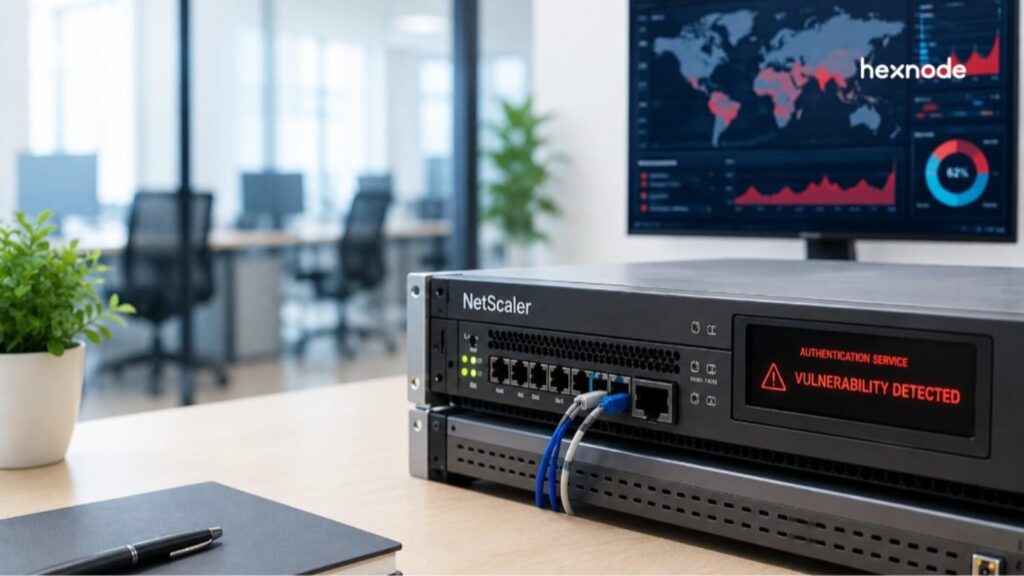
A newly disclosed Citrix NetScaler exploit targeting CVE-2026-8451 has reportedly been observed in probing and exploitation activity shortly after public disclosure. The high-severity vulnerability affects NetScaler ADC and NetScaler Gateway appliances configured as SAML identity providers (SAML IDP), where insufficient input validation can lead to memory disclosure without authentication under affected configurations. Organizations should prioritize patching, review SAML-related traffic, validate exposed appliances, and investigate for signs of suspicious post-exploitation activity.
The Citrix NetScaler exploit involving CVE-2026-8451 has reportedly entered active probing and exploitation shortly after the vulnerability’s public disclosure, highlighting how quickly attackers target internet-facing identity infrastructure once technical details become available.
The high-severity vulnerability affects NetScaler ADC and NetScaler Gateway appliances configured as SAML identity providers (SAML IDP). Under affected configurations, the flaw can disclose portions of appliance memory without requiring authentication, making it a significant concern for organizations that depend on NetScaler for secure remote access, single sign-on (SSO), and identity federation.
With reported exploitation activity already underway, organizations have a limited window to identify exposed systems, apply vendor patches, review SAML-related traffic, and investigate their environments for signs of suspicious activity.
CVE-2026-8451 is a high-severity out-of-bounds read vulnerability affecting Citrix NetScaler ADC and NetScaler Gateway appliances configured as SAML identity providers.
The vulnerability stems from insufficient input validation in NetScaler ADC and NetScaler Gateway when configured as a SAML IDP, leading to memory overread.
In reported exploitation attempts, crafted requests appeared to cause portions of appliance memory to be returned within the NSC_TASS cookie in an HTTP response.
Under vulnerable configurations, exploitation does not require authentication. While this increases the exposure of internet-facing appliances, publicly available reporting has focused on memory disclosure. There has been no public confirmation that exploitation alone results in credential theft, session hijacking, or broader compromise.
Who Is Affected?
Organizations should assess their exposure if they use:
NetScaler ADC
NetScaler Gateway
configured as:
SAML Identity Providers (SAML IDP)
These deployments are commonly used to support:
Single sign-on (SSO)
Identity federation
Secure remote access
Enterprise application delivery
If these appliances are internet-facing, organizations should prioritize patching and review their authentication infrastructure for signs of suspicious activity.
IT Admin’s Guide to Patch Management with Hexnode
Discover how Hexnode streamlines OS updates, automate patch deployment, and maintain endpoint compliance.
Is CVE-2026-8451 Being Actively Exploited?
The following details have been publicly reported:
Affected products: NetScaler ADC and NetScaler Gateway configured as SAML IDPs
Attack type: Remote memory disclosure through an out-of-bounds read
Authentication required: No, under the affected SAML IDP configuration
Observed activity: Reported internet probing and exploitation attempts shortly after disclosure
Observed infrastructure: Third-party reporting cited activity from infrastructure in Frankfurt, Germany, followed by traffic associated with a Koapu Cloud Hong Kong IP address.
At the time of writing:
No threat actor has been publicly identified.
No victim organizations have been publicly disclosed.
No malware has been publicly linked to the activity.
Public reports reviewed for this article did not confirm credential theft, data exfiltration, or persistent access resulting directly from CVE-2026-8451.
Why Should Enterprises Prioritize This Vulnerability?
NetScaler appliances commonly sit at the network edge, protecting authentication services, remote access portals, and enterprise applications. Vulnerabilities affecting these systems deserve immediate attention because they can expose critical identity infrastructure.
Although CVE-2026-8451 is a memory disclosure vulnerability rather than a remote code execution flaw, exposed memory may contain information that could aid follow-on attacks. Combined with the rapid appearance of exploitation attempts after disclosure, this significantly shortens the window available for defenders to respond.
Examining logs for unusual requests targeting SAML endpoints
Investigating endpoint activity for signs of follow-on compromise if suspicious network activity is detected
What Should Security Teams Do Now?
Organizations should follow the vendor’s guidance as soon as possible to reduce exposure.
Recommended actions include:
Apply the latest NetScaler security updates.
If immediate patching is not operationally feasible, consider disabling SAML IDP functionality as a temporary mitigation where it is not required.
Review requests to the /saml/login endpoint for suspicious activity.
Inspect NSC_TASS cookie values for indicators consistent with reported exploitation techniques.
Verify that internet-facing NetScaler appliances are running supported software versions.
Review authentication logs and endpoint telemetry for unusual activity following potential exposure.
Given how quickly exploitation attempts emerged after disclosure, organizations should treat internet-facing appliances as potentially exposed and prioritize review.
Featured resource
Introduction to Hexnode XDR
Get a quick overview of Hexnode XDR and learn how it helps security teams detect, investigate, and respond to endpoint threats through a unified security platform.
While Hexnode cannot remediate vulnerabilities in network appliances such as NetScaler, Hexnode UEM can support endpoint compliance and policy enforcement, while Hexnode XDR can support endpoint-focused investigation and response.
Hexnode UEM
Hexnode UEM can help organizations:
Enforce endpoint compliance policies
Deploy supported operating system updates and application updates to managed endpoints, based on platform and policy support
Use supported conditional access integrations to factor device compliance into access decisions for eligible platforms
Apply security policies consistently across managed devices
These capabilities help maintain a trusted endpoint environment while infrastructure teams address vulnerable network-edge systems.
Hexnode XDR
Following a suspected network-edge incident, Hexnode XDR can support endpoint investigations through:
Historical endpoint activity
Process tree analysis
Query-based investigations
Device isolation
Process termination
File quarantine
These capabilities assist security teams in investigating and responding to suspicious endpoint behavior after a potential compromise. They should not be interpreted as detecting or preventing exploitation of the NetScaler appliance itself.
Hexnode IdP
Organizations using Hexnode IdP can strengthen access controls by implementing:
Multi-factor authentication (MFA)
Role-based access control (RBAC)
Conditional access based on user identity and device compliance
These controls help ensure that only trusted users on compliant devices can access enterprise resources during remediation and recovery efforts.
How can organizations reduce their risk?
Organizations should apply vendor patches, review SAML-related traffic, inspect NSC_TASS cookie values for anomalies, and investigate suspicious activity on affected systems.
Key Takeaways
CVE-2026-8451 affects NetScaler ADC and NetScaler Gateway configured as SAML Identity Providers.
Exploitation attempts were observed shortly after public disclosure.
The vulnerability enables unauthenticated memory disclosure under affected configurations.
Organizations should patch affected appliances as soon as possible.
Endpoint-focused visibility, device compliance, and endpoint investigation remain important while remediation is underway.
Although important questions remain—including threat actor attribution and the full extent of successful exploitation—the priorities for defenders are already clear: identify vulnerable NetScaler deployments, apply vendor patches without delay, review SAML-related activity, and investigate any suspicious endpoint behavior that follows.
For enterprise security teams, this incident reinforces the importance of disciplined patch management, continuous visibility into internet-facing infrastructure, and coordinated monitoring across identity systems and managed endpoints.
Stay Ahead of Emerging Cyber Threats
Get timely cybersecurity news, vulnerability updates, endpoint security best practices, and enterprise IT insights.
I write at the intersection of technology, process, and people, focusing on explaining complex products with clarity. I break down tools, systems, and workflows without any noise, jargon, or the hype.