Why are endpoints still difficult to secure in Zero Trust environments?
Endpoints remain difficult to secure in Zero Trust environments because they are constantly changing trust points. XDR and Zero Trust strategies address this challenge by connecting endpoint activity with identity, access, and risk context. A user may move between networks, a device may fall out of compliance, an application may introduce new risk, and identity or access signals may shift throughout the day. This makes endpoint trust dynamic, not fixed.
For Security Admins, SOC Analysts, and CISOs, the challenge is not simply having too few tools. Endpoint data often sits across disconnected systems, leading to:
Fragmented telemetry across endpoint, identity, network, and access tools
Inconsistent device posture checks across managed and unmanaged devices
Access visibility gaps created by remote work, SaaS usage, unmanaged devices, and unsanctioned applications.
High alert volumes that make prioritization harder for SOC teams
This creates a visibility-and-verification gap. A device that was trusted during login may not remain trustworthy after a risky process starts, a policy changes, or suspicious access behavior appears. Effective XDR and Zero Trust strategies depend on continuously validating endpoint state, identity context, and access behavior together.
What happens when endpoint trust is assumed instead of continuously verified?
When endpoint trust is assumed, compromised users or devices can continue accessing corporate resources without triggering the right level of scrutiny. This creates blind spots where attackers can use valid credentials, trusted devices, or approved applications to operate inside the environment.
The business impact includes:
Lateral movement across systems after initial compromise
Delayed detection when endpoint and identity signals are reviewed separately
Breach exposure from continued access by risky users or devices
Compliance gaps when access decisions lack current posture validation
Wasted SOC hours spent triaging duplicate or low-context alerts
Alert fatigue compounds the problem. When SOC teams cannot correlate endpoint activity with identity and access behavior, they investigate isolated symptoms instead of the likely attack path. A suspicious login, abnormal process, or policy deviation may look low priority alone, but together they can indicate a higher-risk compromise that requires immediate containment.
What is XDR in a Zero Trust security model?
XDR is a detection and response approach that correlates signals across security layers to help teams detect, investigate, and coordinate threat response more effectively. In a Zero Trust security model, XDR provides the threat context needed to verify whether users, devices, sessions, and activities should continue to be trusted.
Zero Trust is commonly guided by three foundational principles:
Continuous verification of users, devices, sessions, and access behavior
No implicit trust based only on user identity, device ownership, or network location
Access decisions should depend on the current context, not one-time authentication. This includes who the user is, what device they use, where the request comes from, what resource they access, and whether the activity matches expected behavior.
XDR does not replace Zero Trust. It strengthens Zero Trust by supplying behavioral signals, endpoint telemetry, threat context, and response workflows when risk changes.
Zero Trust and cybersecurity with Hexnode MDM
Learn how Hexnode UEM supports Zero Trust security for managed endpoints.
Why does Zero Trust need endpoint telemetry?
Zero Trust needs endpoint telemetry because identity alone cannot prove that a session is safe. Access decisions require trustworthy signals from the device, user, policy, and security environment.
Key endpoint signals include:
Device health
User behavior
Authentication context
Policy compliance
Suspicious endpoint activity
In a Zero Trust model, XDR strengthens continuous verification by adding endpoint telemetry, behavioral signals, and threat context to access decisions. In a Zero Trust model, it strengthens continuous verification by adding endpoint telemetry, behavioral signals, and threat context to access decisions.
A valid identity alone is not enough if the device is compromised, unmanaged, misconfigured, or exposed. For example, a user may pass authentication while XDR detects suspicious process activity or unusual file behavior on the same endpoint, changing the risk context for investigation or containment.
How do XDR and Zero Trust work together to secure endpoints?
XDR helps Zero Trust move from static access checks to continuous risk-based security. Zero Trust limits access based on identity, device posture, and policy context, while XDR detects threats and provides the investigation details needed to respond when endpoint risk changes.
The relationship works as a feedback loop:
Collect endpoint signals from devices, processes, files, alerts, and activity patterns
Correlate telemetry with identity, authentication, and access behavior
Detect suspicious patterns that indicate compromise, misuse, or policy deviation
Trigger response actions such as investigation, containment, or remediation workflows
Refine access decisions based on updated risk and endpoint posture
This is where XDR and Zero Trust become operationally stronger together. Zero Trust reduces unnecessary access, but XDR shows when trusted access becomes risky. For SOC teams, that context reduces manual investigation effort and helps connect endpoint events with identity and access behavior before an incident expands.
How XDR and Zero Trust support endpoint security –
Endpoint Security Area
Zero Trust Role
XDR Role
Device posture
Verifies whether the endpoint meets trust requirements
Supplies endpoint health, behavior, and threat signals
Correlates identity activity with endpoint behavior
Risk-based access
Uses risk context to influence access decisions
Detects suspicious patterns across endpoint and security telemetry
Risk-based response
Restricts or adjusts access when risk increases
Supports investigation, containment, and remediation workflows
Continuous verification
Reassesses trust based on changing context
Provides updated telemetry for risk-based decisions
How can security teams implement XDR and Zero Trust for endpoint protection?
Security teams should implement XDR and Zero Trust for endpoint protection by starting with endpoint visibility, then adding identity-aware access controls, telemetry correlation, and response automation. The goal is to verify endpoint risk continuously, not only at login or enrollment.
This approach reduces the operational gap between detection and enforcement. Instead of reviewing disconnected alerts across multiple consoles, teams can connect endpoint activity with identity and access behavior. That improves triage quality and gives analysts clearer escalation paths.
Mature implementation can support fewer low-context alerts, faster investigation, more consistent response decisions, and improved MTTD and MTTR when telemetry, access controls, and response workflows are properly operationalized.
Step 1: Define what a trusted endpoint means for your organization
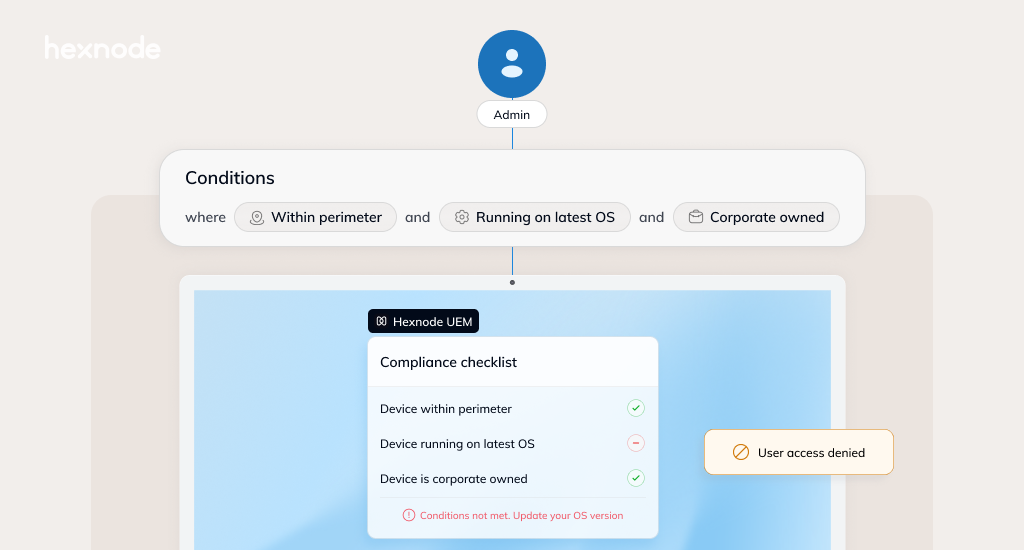
A trusted endpoint should meet defined posture requirements before accessing sensitive resources. These may include enrollment status, OS version, patch level, encryption, active security controls, configuration posture, and ownership type.
Device trust and user trust must be evaluated together. A valid user on a risky device, or a compliant device with suspicious credentials, should not receive unrestricted access.
CISOs and SecOps leaders should map endpoint trust rules to business risk, compliance needs, and resource sensitivity. High-risk systems should require stricter posture checks than low-risk applications.
Step 2: Correlate endpoint, identity, and access signals before acting
Correlation is essential because a single alert may be noisy, incomplete, or low priority on its own. Combined signals can reveal a meaningful attack pattern that isolated tools may miss.
Security teams should correlate signals such as:
Risky sign-ins from unfamiliar locations or devices
Unusual process behavior on the endpoint
Privilege changes or abnormal admin activity
Suspicious file execution or malware-like behavior
Non-compliant devices requesting access to sensitive resources
Repeated access attempts after denial or policy failure
This correlation forms the bridge between XDR detection and Zero Trust enforcement. XDR helps identify what is happening on the endpoint, while Zero Trust determines whether access should continue, be restricted, or require further verification. Together, they support decisions based on current risk rather than static trust.
Step 3: Build response workflows that reduce alert fatigue
Response workflows should define what happens when endpoint risk increases. Depending on severity, teams may investigate, isolate the endpoint, restrict access, quarantine suspicious files, revoke sessions, or escalate the incident.
SOC teams can reduce manual effort by prioritizing alerts based on:
Asset criticality
User privilege
Threat severity
Endpoint posture
Access sensitivity
This helps analysts focus on alerts that carry real business risk instead of treating every signal with equal urgency.
Teams should also avoid broad over-automation. High-impact actions such as isolation, access revocation, or privilege restriction should be tested, documented, and reviewed before wide enforcement. Automation should accelerate response without creating avoidable business disruption.
How Hexnode fits into XDR and Zero Trust endpoint security
Hexnode supports XDR and Zero Trust endpoint security by helping teams define device trust, align compliance with access decisions, and respond to endpoint threats through security operations workflows.
With Hexnode UEM Compliance Policies, administrators can use basic and advanced compliance settings to mark devices non-compliant when they fail to configure compliance criteria. Through Microsoft Entra Conditional Access integration, Hexnode can provide compliance data for enrolled and managed Android, iOS, and macOS devices so access decisions can depend on device compliance status.
For threat detection and response on Windows endpoints, Hexnode XDR supports telemetry correlation mapped to MITRE ATT&CK, endpoint isolation, Kill Process, Kill Process Tree, Delete Process, Quarantine File, and endpoint telemetry queries through the Investigate tab.
For threat detection and response, Hexnode XDR supports automated alert correlation mapped to MITRE ATT&CK, endpoint isolation, Kill Process, Kill Process Tree, Delete the Process Root, Quarantine File, and threat-hunting queries through its query engine.
These capabilities help security teams investigate suspicious endpoint behavior, contain active threats, and query endpoint telemetry during incident analysis.
Featured resource
Introduction to Hexnode XDR
Hexnode XDR connects endpoint visibility, threat correlation, and response workflows to strengthen enterprise security operations.
Building stronger endpoint trust with XDR and Zero Trust
Endpoint trust cannot depend on one-time authentication or static device checks. Security teams should define trusted endpoint criteria, validate device posture continuously, connect endpoint telemetry to access decisions, and prepare response workflows for high-risk activity. This helps reduce blind spots between IT operations and SecOps while improving how teams detect, investigate, and respond to threats.
Hexnode is relevant for organizations that want to align endpoint compliance, conditional access, and XDR-driven response within a unified endpoint security strategy. Explore Hexnode’s endpoint security and XDR capabilities or request a demo to see how endpoint trust and threat response can work together.
Strengthen endpoint trust with Hexnode XDR
Start your 14-day free trial and improve endpoint threat response.
Can XDR support Zero Trust without replacing existing tools?
Yes. XDR can support Zero Trust by correlating signals from existing endpoint, identity, network, and cloud tools. It adds threat context that helps teams make better access and response decisions.
What metrics should teams track after implementing XDR and Zero Trust?
Teams should track MTTD, MTTR, alert volume, false positive rates, endpoint compliance rates, policy violations, and incidents involving unmanaged or non-compliant devices. These metrics show whether detection and response are improving.
How often should endpoint trust policies be reviewed?
Endpoint trust policies should be reviewed after major changes in devices, access requirements, compliance rules, security tools, or threat patterns. Teams should also review them periodically to keep trust rules aligned with business risk.
A storyteller for practical people. Breaks down complicated topics into steps, trade-offs, and clear next actions—without the buzzword fog. Known to replace fluff with facts, sharpen the message, and keep things readable—politely.