TL; DR
Understanding autonomous vs automated remediation helps enterprises evaluate how security decisions should be handled. Automated remediation follows predefined rules, while autonomous remediation uses contextual analysis and AI-assisted decision-making to adapt responses dynamically. As security environments grow more complex, organizations may evaluate human-supervised remediation models that balance automation with administrative oversight.
Modern cyberattacks increasingly use automation and fast-moving techniques, making autonomous vs automated remediation a growing focus for enterprise security teams. As organizations work to improve incident response speed, remediation strategies have become central to modern endpoint security and XDR operations.
While automated and autonomous remediation are often discussed together, they represent very different approaches to security operations. Automated remediation executes predefined response actions based on established policies, whereas autonomous remediation attempts to make adaptive, context-aware decisions with minimal human intervention.
Understanding the distinction is critical for enterprises evaluating endpoint security strategies, operational resilience, and the balance between response speed and administrative control.
Modernize Endpoint Operations
Why Remediation Speed Matters in Modern Cybersecurity?
Enterprise security environments have become significantly more complex over the last few years. Organizations now manage a mix of corporate-owned and personal devices, remote users, cloud-native applications, and geographically distributed endpoints across multiple operating systems. This growth has also widened the enterprise attack surface.
Several factors continue to increase security exposure:
- Remote and hybrid work environments
- Bring Your Own Device (BYOD) adoption
- Cloud and SaaS application sprawl
- Distributed endpoint ecosystems
- Third-party and unmanaged access points
At the same time, many modern threats can progress faster than manual investigation and response workflows. Ransomware operators, credential theft campaigns, and lateral movement techniques can progress quickly after initial compromise, reducing the effectiveness of slow manual response cycles.
Manual investigation and response cycles may struggle to keep pace, especially in large enterprise environments with limited SOC resources.
Delayed remediation increases operational and compliance risk. As a result, remediation has become a critical component of modern endpoint security strategies.
Automated and autonomous remediation models can help organizations reduce response times, improve operational efficiency, and strengthen cyber resilience. The discussion around autonomous vs automated remediation is becoming increasingly relevant as organizations modernize security operations.
What Is Automated Remediation?
Automated remediation refers to the execution of predefined response actions when specific security conditions or policy violations are detected. It forms the foundation of modern security automation strategies by helping organizations reduce manual intervention during incident response and endpoint management workflows.
At its core, automated remediation operates on rule-based logic. Security teams define policies, triggers, and response actions in advance, allowing systems to execute remediation workflows automatically when predetermined conditions are met.
For example, if an endpoint detects known ransomware behavior, the system may automatically isolate the device, terminate the malicious process, and generate an alert for further investigation.
These workflows are typically governed through administrator-defined playbooks and compliance policies.
Common Automated Remediation Actions
Modern endpoint security and UEM platforms commonly support actions such as:
- Device isolation
- Process termination
- Malware quarantine
- Automated patch management
- Forced password resets
- Compliance enforcement actions
These capabilities help organizations respond quickly without requiring constant analyst intervention.
Benefits of Automated Remediation
Automated remediation provides several operational advantages:
- Faster response and reduced manual workload
- Consistent policy enforcement
- Better operational scalability
For enterprises managing large endpoint environments, automation can reduce repetitive manual work for security and IT operations teams.
Limitations of Automated Remediation
Despite its advantages, automated remediation has limitations. The system only executes actions it has been explicitly configured to perform.
As a result, automated remediation often struggles with:
- Limited contextual reasoning
- Dependence on predefined rules
- Difficulty handling unknown or evolving attack patterns
This limitation is one of the key reasons organizations are exploring more adaptive remediation models.
What Is Autonomous Remediation?
Autonomous remediation extends beyond traditional security automation by introducing adaptive, context-aware decision-making into the remediation process. Instead of executing only predefined actions, autonomous systems attempt to evaluate the broader security context and determine the most appropriate response dynamically.
In traditional automated remediation, workflows follow fixed rules established by administrators. Autonomous remediation shifts some of that decision-making to the platform itself. The system analyzes telemetry, behavioral patterns, risk indicators, and environmental context before selecting a remediation path.
Some autonomous remediation models incorporate AI-assisted analysis to support faster operational decisions. However, many enterprise platforms operate within policy-defined boundaries rather than fully independent decision-making frameworks.
Key Characteristics of Autonomous Remediation
Autonomous remediation platforms typically emphasize capabilities such as:
- Dynamic response selection
- Behavioral and anomaly analysis
- Risk-based prioritization
- Contextual decision-making
- Reduced human intervention
Rather than following a static playbook, the platform continuously evaluates the situation and adjusts response actions accordingly.
Example of Autonomous Remediation in Practice
An autonomous remediation system may correlate endpoint telemetry, analyze behavioral indicators, evaluate system sensitivity, and adjust containment actions dynamically as new information becomes available.
In this model, the remediation workflow evolves in real time rather than relying entirely on predefined rules. This adaptive approach allows security platforms to respond more flexibly to changing threat conditions while reducing the need for constant manual intervention.
Challenges With Full Autonomy
Despite its potential, fully autonomous remediation introduces several enterprise concerns.
Organizations must account for:
- Risk of operational disruption
- False positives triggering unnecessary actions
- Governance and approval challenges
- Compliance and auditability requirements
For example, an incorrectly isolated production device or blocked administrator account can create significant business impacts. Because of these risks, controlled automation models with human oversight are often appropriate for critical response workflows.
Autonomous vs. Automated Remediation: Key Differences
The primary difference between autonomous and automated remediation lies in how remediation decisions are made. Automated remediation executes predefined actions based on administrator-configured rules, while autonomous remediation attempts to evaluate context and determine response actions dynamically.
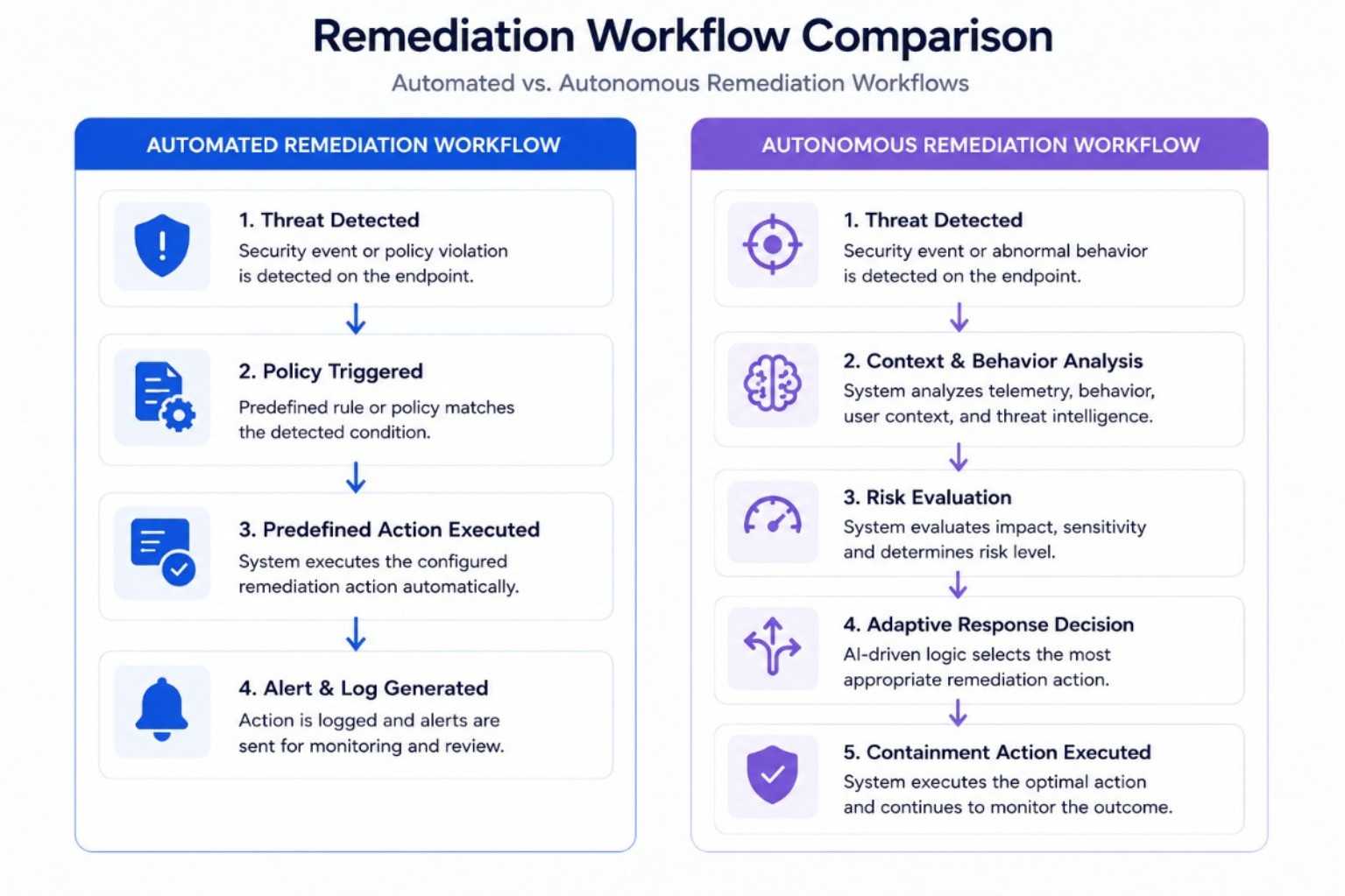 Workflow comparison diagram showing automated vs autonomous remediationThis distinction has significant implications for operational control, governance, scalability, and risk management in enterprise security environments.
| Automated Remediation |
Autonomous Remediation |
| Uses predefined workflows |
Uses adaptive workflows |
| Rule-driven execution |
Context-driven decision-making |
| Relies on administrator-authored logic |
Incorporates AI-assisted reasoning |
| High operational predictability |
Dynamic and evolving responses |
| Requires more direct human oversight during workflow design |
Aims to reduce human intervention during execution |
| Limited flexibility for unknown threats |
Designed to adapt to changing threat conditions |
| Easier to audit and govern |
More complex governance requirements |
| Lower dependency on behavioral analysis |
Higher dependency on telemetry and contextual analysis |
In practical enterprise environments, the debate around automated vs autonomous cybersecurity is less about choosing one model over the other and more about balancing operational speed with control.
Automated remediation remains widely used because it provides predictable and policy-aligned execution. Autonomous remediation offers greater adaptability, but it also introduces concerns around false positives, governance, and unintended operational impact.
A practical priority is building intelligent automation workflows that accelerate response while maintaining administrative oversight and auditability. The distinction between autonomous vs automated remediation directly affects governance, operational control, and incident response strategy.
Why Most Enterprises Still Rely on Automated Remediation?
Despite growing interest in AI-driven security operations, automated remediation remains a practical option where predictable and policy-defined response is required. In enterprise environments, remediation decisions can directly impact business continuity, production systems, user productivity, and regulatory compliance.
Security teams cannot afford uncontrolled response actions in critical environments. An incorrectly isolated server, terminated business application, or blocked privileged account can create operational disruption that rivals the original security incident itself. Because of this, enterprises prioritize remediation models that are predictable, governed, and auditable.
The Need for Human Oversight
Human oversight remains essential in enterprise remediation workflows. Security teams often need to evaluate:
- Business criticality of affected systems
- Potential operational impact of containment actions
- Whether suspicious behavior is genuinely malicious
- Dependencies across infrastructure and applications
In many cases, contextual business awareness matters as much as technical detection accuracy.
Regulatory and Compliance Considerations
Enterprise security operations also require strong governance and accountability.
- Most organizations must maintain:
- Detailed audit trails
- Policy-driven enforcement mechanisms
- Approval workflows for sensitive actions
- Documentation for compliance reporting
Many regulatory and governance frameworks require organizations to maintain evidence of security decisions, controls, and authorization processes. Fully autonomous remediation models may complicate these requirements if decision-making processes lack transparency or explainability.
The Ultimate Guide to XDR (Extended Detection and Response)
Understand how XDR unifies detection, investigation, and response workflows to help improve threat remediation.
How Hexnode Enables Faster, Smarter Remediation?
Modern enterprise security operations require more than isolated detection tools. Security and IT teams need centralized visibility, rapid response capabilities, and consistent policy enforcement across distributed endpoint environments. Platforms that combine endpoint management and security operations can support endpoint remediation workflows and centralized response management.
Hexnode combines UEM and XDR workflows to support detection, validation, and remediation actions such as device isolation, process termination, and patch management.
Hexnode supports policy-driven remediation workflows that allow administrators to define and manage response actions.
Automated Security Response with Hexnode
Hexnode supports several automated endpoint response capabilities, including:
- Device isolation
- Process termination
- Compliance enforcement actions
- Patch and configuration management
These capabilities allow IT and security teams to execute endpoint response actions across managed devices.
For large endpoint fleets, UEM security automation can help standardize remediation workflows and reduce repetitive manual tasks.
Explore Security Operations with Hexnode
Endpoint Visibility and Investigation
Effective remediation depends on endpoint visibility and operational context. Hexnode XDR and UEM workflows help security teams validate detected anomalies and execute response actions such as device isolation and process termination.
Key visibility and monitoring capabilities include:
- Activity Feed monitoring
- Centralized endpoint visibility
- Process termination targeting specific processes and associated process trees
- Remediation action tracking and audit validation
These capabilities help teams monitor remediation activity and review executed endpoint actions during security operations.
Why Controlled Automation Matters
Enterprises often need faster remediation without relinquishing operational control. Hexnode supports automated endpoint response workflows within administrator-defined boundaries.
Hexnode UEM supports administrator-defined automation workflows for policy, patch, script, and configuration actions, while Hexnode XDR supports active threat containment actions such as process neutralization and network isolation.
The Future of Remediation: Human-Supervised Intelligence
The future of enterprise remediation is unlikely to be fully autonomous. Instead, organizations are moving toward human-supervised intelligence, where AI-assisted systems help accelerate decision-making while administrators retain operational control.
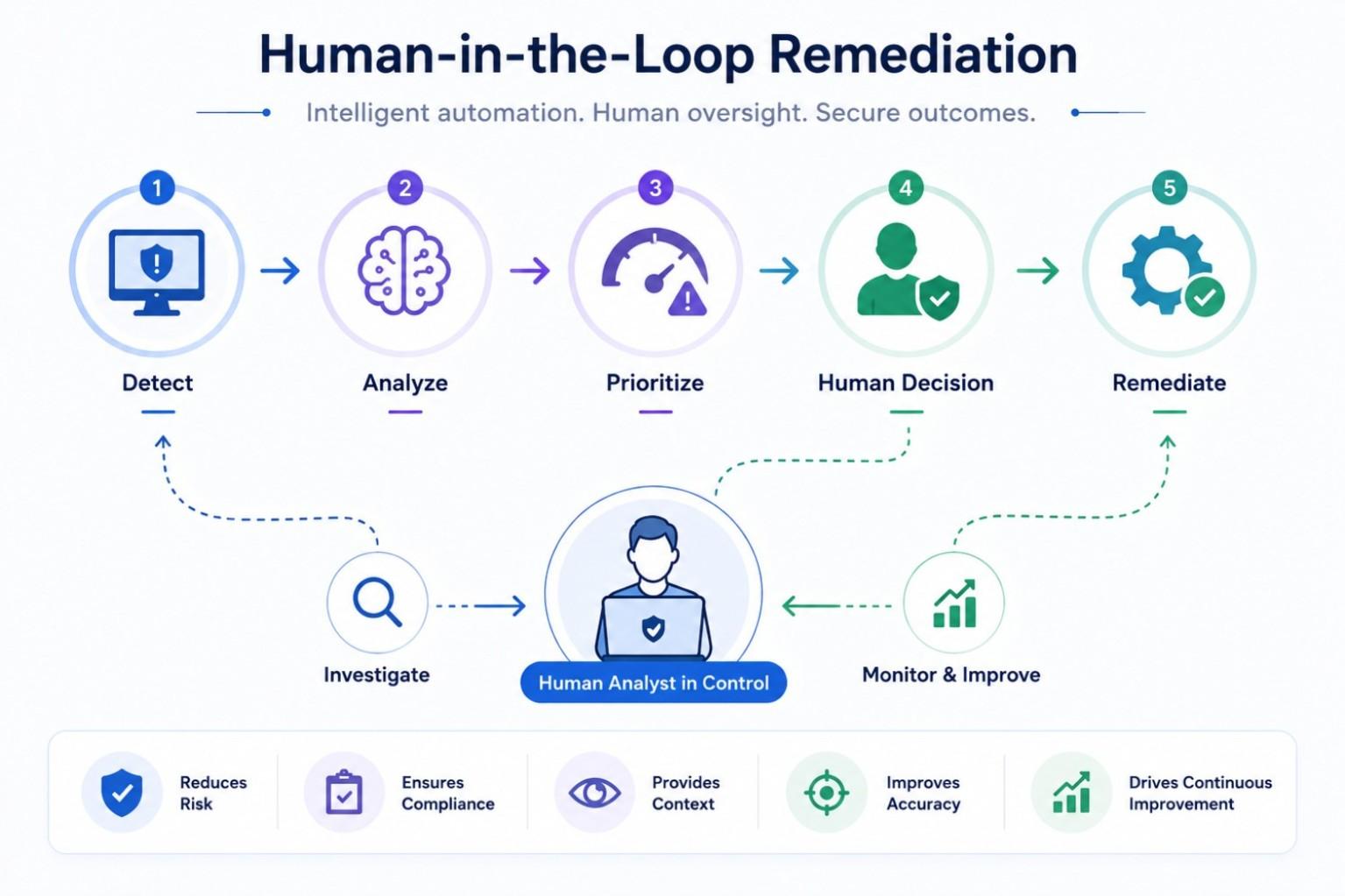 Human-in-the-loop remediation workflow Security operations centers may face alert fatigue, staffing constraints, and increasing infrastructure complexity. Industry threat landscape reports continue to highlight the growing complexity and scale of modern enterprise attack surfaces.
As a result, organizations may evaluate platforms that combine automation, investigation support, threat prioritization, and context-aware remediation recommendations within policy-defined workflows.
AI-assisted workflows may expand support for threat correlation, risk scoring, behavioral analysis, and recommended containment actions. However, enterprises still require human validation for sensitive operational decisions, particularly in regulated or mission-critical environments.
In practice, the future of remediation will likely center on assisted autonomy, intelligent automation, and human-supervised response orchestration.
Conclusion
Ultimately, the debate around autonomous vs automated remediation centers on balancing automation speed with operational oversight. The difference between automated and autonomous remediation comes down to how remediation decisions are made. Automated remediation follows predefined rules and policies, while autonomous remediation introduces adaptive, context-aware decision-making with reduced human involvement.
As enterprise security operations evolve, controlled automation remains valuable where predictability, auditability, and operational stability are critical. Platforms like Hexnode help organizations accelerate incident response through centralized visibility and administrator-controlled remediation workflows.
The future of remediation will likely center on intelligent automation supported by human-supervised decision-making rather than fully independent security operations.
Accelerate Endpoint Response Without Losing Control
See how Hexnode helps IT and security teams streamline endpoint remediation with centralized visibility and automated response actions.
Sign Up NowFAQs
Can autonomous remediation completely replace SOC analysts and IT teams?
No. Most enterprise environments still require human oversight for sensitive remediation decisions. Autonomous systems can assist with prioritization, analysis, and response recommendations, but organizations often keep administrators involved to reduce operational risk and maintain control over critical response actions.
Why do enterprises prefer automated remediation over fully autonomous remediation?
Enterprises prioritize predictability, auditability, and operational control. Automated remediation follows predefined policies and workflows, making it easier to govern, validate, and align with compliance requirements. Fully autonomous actions can introduce risks if remediation decisions affect critical systems or business operations.
Does autonomous remediation always rely on AI?
Not necessarily. Autonomous remediation often incorporates AI-assisted analysis, but most enterprise platforms still operate within administrator-defined boundaries. Many solutions use contextual analysis and predefined policies together rather than relying entirely on independent AI-driven decision-making.