Ivanti EPMM CVE-2026-6973 is an actively exploited improper input validation flaw affecting on-premises Ivanti Endpoint Manager Mobile versions before 12.6.1.1, 12.7.0.1, and 12.8.0.1. CISA added it to the KEV catalog on May 7, 2026, with a May 10, 2026 remediation deadline. The flaw enables remote code execution, but only for a remotely authenticated user with administrative access, so it should not be confused with a simple authentication bypass. Organizations should patch immediately, review admin accounts, rotate credentials, restrict management access, and strengthen the broader mobile management control plane.
Mobile device management platforms sit at the center of enterprise mobility. They enforce device policies, manage access configurations, support enrollment workflows, and often connect to broader identity and security systems. So, when a vulnerability affects the management plane itself, the risk is not limited to one application or one server. It can create a path toward broader control over the mobile environment.
That is why Ivanti EPMM CVE-2026-6973 deserves urgent attention.
On May 7, 2026, CISA added CVE-2026-6973, an Ivanti Endpoint Manager Mobile vulnerability, to its Known Exploited Vulnerabilities catalog. The listed due date for remediation was May 10, 2026, meaning the federal remediation window has already closed as of May 11, 2026.
But the urgency is not only about the deadline. It is about what can happen when administrative access, weak input validation, and a high-value management platform intersect. To understand the risk, we first need to look at what actually happened.
Ivanti’s May 2026 EPMM security update addressed multiple vulnerabilities in Ivanti Endpoint Manager Mobile, but CVE-2026-6973 was the flaw that turned the advisory into an emergency.
Affected versions: EPMM versions before 12.6.1.1, 12.7.0.1, and 12.8.0.1.
Vulnerability type: Improper input validation.
Impact: Remote code execution on the affected EPMM system.
Attack condition: Exploitation requires a remotely authenticated user with administrative access.
NVD describes the flaw as an improper input validation vulnerability that can allow a remotely authenticated user with administrative access to achieve remote code execution in affected Ivanti EPMM versions. NVD also lists the vulnerability as CVSS 7.2 High, with network attackability, low attack complexity, high privileges required, no user interaction, and high confidentiality, integrity, and availability impact.
Who are Exposed to the Vulnerability?
Organizations running on-premises Ivanti EPMM versions earlier than 12.6.1.1, 12.7.0.1, or 12.8.0.1 are affected. Ivanti stated that the issue does not affect Ivanti Neurons for MDM, Ivanti EPM, Ivanti Sentry, or other Ivanti products. The highest-priority environments are on-prem EPMM deployments that are internet-facing, broadly reachable, or managed with credentials that may not have been rotated after earlier EPMM incidents.
Why CVE-2026-6973 is Serious
CVE-2026-6973 is not a simple authentication bypass or unauthenticated takeover. The attacker needs admin-level access first. This means, an attacker needs a privileged foothold before exploitation. But in real-world incidents, admin access is often obtained through phishing, credential theft, token compromise, password reuse, or earlier exploitation.
The real concern is what EPMM controls. A mobile management platform is not just another application server. It can sit close to device enrollment, mobile policies, certificates, VPN profiles, access configurations, and compliance workflows. If attackers can move from stolen or compromised admin access to code execution on the EPMM system, the risk expands from one vulnerable server to the broader mobile management plane.
That is why this vulnerability should be treated as a control-plane security issue. Depending on the environment, a compromise could create opportunities for policy tampering, persistence, data exposure, operational disruption, or further movement across connected systems. The urgency of CISA’s KEV deadline reflects that risk.
IT Admin’s Guide to Patch Management with Hexnode
Learn more about how Hexnode simplifies patch management with centralized patch deployment and automation.
The Bigger Lesson: Secure the Management Plane
CVE-2026-6973 is not only a patching event. It is a reminder that endpoint and mobile management platforms are part of the enterprise security control plane. And this control plane needs more than periodic updates. It needs:
Strong administrative access controls,
Device-aware authentication,
Continuous compliance checks,
Visibility into endpoint and admin activity,
Fast containment when suspicious behavior appears.
The management console should not be treated like a normal web application. It should be protected like a critical security system, because that is exactly what it is.
How Hexnode Can Help Reduce Management-plane Risk
Hexnode does not patch Ivanti EPMM. Organizations affected by CVE-2026-6973 still need to apply Ivanti’s fixed versions or follow vendor mitigation guidance.
Where Hexnode fits is in the broader security architecture around endpoint governance, device trust, access control, patch visibility, and response.
Hexnode UEM: Strengthen Endpoint Governance
Hexnode UEM is designed to manage devices across platforms including Windows, macOS, Android, iOS, tvOS, FireOS, ChromeOS, Linux, and visionOS. It gives IT teams centralized control across a growing workforce and diverse device fleet.
In the context of an EPMM incident, this visibility is crucial. IT teams need to know which devices are compliant, which policies are active, whether critical profiles have changed, and whether endpoints are still operating within approved baselines. Hexnode’s patch and update management capabilities also support pre-approval, assignment to devices or groups, and scheduled installation.
Hexnode IdP and Access: Tie Access to Device Trust
Credential theft remains one of the biggest reasons administrative access controls fail. A password alone is not enough to prove that a login should be trusted.
Hexnode IdP focuses on combining user identity with device posture. Its zero-trust access built on device trust unifies user identity and device posture to secure access across devices and applications. It also supports conditional access rules based on identity, device compliance, and security context.
That is the right direction for management-plane security. Admin access should depend not only on who the user is, but also on whether the device is managed, compliant, encrypted, healthy, and operating from an approved context.
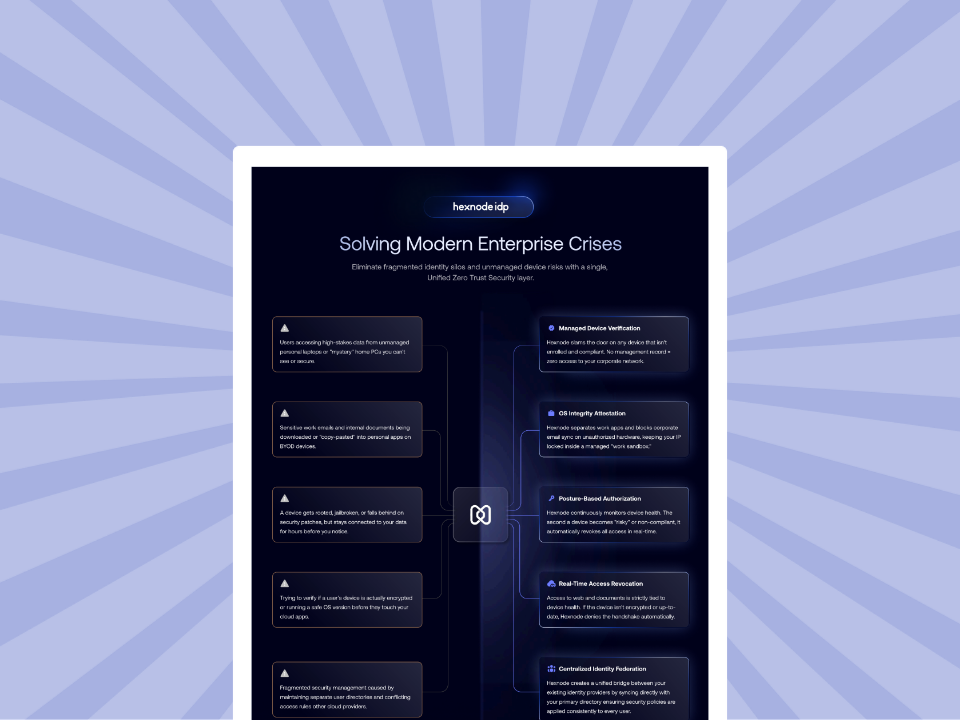
Infographic
Hexnode IdP use cases
Check out this document for a quick glance into Hexnode IdP's capabilities.
Hexnode UEM also integrates with an identity provider’s conditional access engine, such as Microsoft Entra ID or Okta. Here access decisions can adapt to device security posture and managed state, and non-compliant devices can trigger blocking or step-up authentication through the IdP.
For organizations trying to reduce the risk of administrative compromise, this is a practical control. Even if credentials are stolen, access can be challenged or blocked when the device does not meet compliance requirements.
Hexnode XDR: Improve Visibility and Response
When attackers gain privileged access, speed matters. Security teams need to detect suspicious activity, investigate quickly, and contain affected endpoints before the incident spreads.
Hexnode XDR acts as a unified detection and response solution that provides contextualized alerts, automated correlation, coordinated response, threat hunting, audit trails, and endpoint visibility. It also provides response actions such as isolating devices, killing malicious processes, and quarantining files.
In a management-plane incident, XDR-style visibility can help security teams investigate suspicious endpoint behavior, correlate events, and contain compromised devices faster.
Patch Now, Then Reduce Exposure
CVE-2026-6973 shows how quickly a management-platform vulnerability can become an urgent security priority. CISA added the flaw to its KEV catalog on May 7, 2026, with a May 10, 2026 remediation deadline. The issue affects on-prem Ivanti EPMM versions before 12.6.1.1, 12.7.0.1, and 12.8.0.1, and exploitation requires a remotely authenticated user with administrative access.
Affected organizations should patch immediately, review admin accounts, rotate credentials, restrict access, and examine logs. Beyond this CVE, the lesson is clear: mobile management platforms are part of the enterprise control plane and need stronger exposure reduction, device-aware access, and continuous visibility.
Secure Endpoint Control Beyond the Patch
CVE fixes are only the first step. Strengthen your mobile management plane with centralized endpoint visibility, compliance-driven access, and device-aware security policies through Hexnode UEM.
Curious, constantly learning, and turning complex tech concepts into meaningful narratives through thoughtful storytelling. Here I write about endpoint security that are grounded in real IT use cases.