TL; DR
Identity-only authentication leaves a critical gap. Users can access apps from unmanaged or insecure devices, increasing breach risk. Okta Device Trust addresses this gap by adding device compliance checks to authentication, ensuring access decisions consider both user identity and device posture.
With Hexnode UEM, organizations enforce and monitor device compliance, which can then inform identity-layer access controls. The result is stronger alignment with Zero Trust principles, reduced risk of credential misuse, and more consistent access policy enforcement across applications.
Introduction
Identity-centric access controls no longer provide sufficient security in modern SaaS environments. Organizations continue to enforce strong authentication mechanisms, yet users can still access critical applications from unmanaged, unpatched, or compromised devices. This creates a structural gap. The user is verified, but the device posture remains unknown. Okta Device Trust addresses this gap.
As a result, attackers can exploit valid credentials on insecure endpoints to gain footholds in enterprise systems. This directly undermines Zero Trust principles, where access decisions must consider both identity and device context. Without enforcing device-level controls, organizations risk data exposure, compliance violations, and lateral movement.
By extending authentication workflows to include device compliance validation, access can be configured to require both user authentication and device compliance before granting access.
This is where Hexnode becomes operationally critical. It enables device compliance enforcement through UEM, allowing administrators to define and monitor security policies across managed devices.
Explore Hexnode UEM
What is Okta Device Trust?
Okta Device Trust is an access control mechanism that enforces device-level validation during authentication. It enables organizations to restrict access to enterprise applications based on whether devices are enrolled, managed, and compliant with defined security policies, depending on configured access rules.
Instead of relying solely on user identity, Device Trust introduces device posture checks into the authentication flow. These checks evaluate parameters such as:
- Device management status
- Security configurations like encryption and passcode enforcement
- OS version and patch compliance
Access decisions are then made based on a combination of identity verification and device compliance status.
This approach aligns with Zero Trust principles, where trust is not assumed based on credentials alone. It reduces the risk of credential-based attacks originating from unmanaged or compromised endpoints by limiting access to trusted and compliant devices.
Why does Okta Device Trust Matter?
Modern access control must account for both who is accessing and what they are accessing from. Without device validation, organizations leave a critical gap that attackers can exploit using valid credentials on insecure endpoints.
Okta Device Trust enables organizations to enforce access based on whether devices are managed and compliant, depending on configured policies. This directly reduces exposure to:
- Unauthorized access from unmanaged or unknown endpoints
- Credential misuse on infected or poorly secured devices
It strengthens Zero Trust architectures by allowing device posture to be enforced as a condition for access. Before granting entry, organizations can enforce compliance checks such as:
- Full disk encryption
- Minimum OS version and patch levels
- Passcode and security configurations
As a result, access policies remain consistent across SaaS and internal applications, ensuring uniform enforcement regardless of where the app is hosted. This improves security posture while maintaining centralized control over endpoint access.
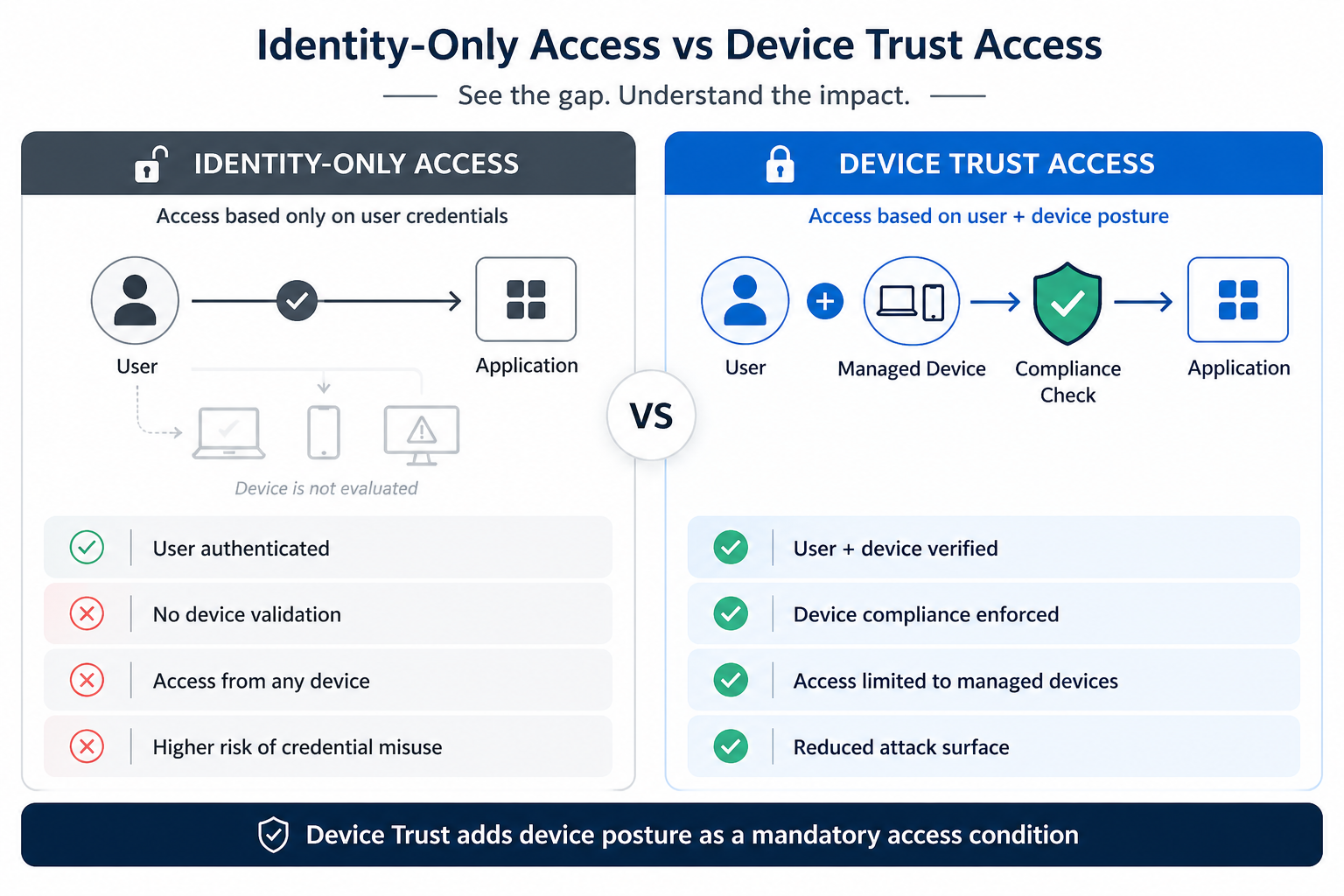 Identity-Only Access vs Device Trust Access
Challenges in Enforcing Device Trust
Implementing device trust introduces operational and architectural challenges, especially in heterogeneous environments.
No real-time compliance validation at login
Some organizations rely on periodic device checks, which can create gaps where devices drift out of compliance.
Fragmentation between identity and endpoint tools
In some environments, identity providers and UEM platforms operate in silos, which can limit consistent enforcement of device-aware access decisions.
Policy inconsistency across device types
Managing compliance across Windows, macOS, iOS, and Android requires aligned policy baselines, which can be difficult to standardize.
Limited visibility at the point of access
Without integrated signals, IT teams lack accurate, real-time device posture data during authentication, weakening enforcement, and increasing risk exposure.
Implementing Zero Trust Access: The Hexnode and Okta Integration Guide
Learn how Hexnode's Okta integration streamline identity management, providing secure, and seamless single sign-on.
How Hexnode Enables Okta Device Trust
1. Device Compliance Enforcement with Hexnode UEM
Hexnode UEM enforces and monitors endpoint compliance by applying security policies across managed devices. It allows IT teams to define and apply baseline security policies across managed devices, including:
- Full disk encryption enforcement
- Passcode and authentication requirements
- OS version and patch compliance thresholds
These policies are evaluated based on device check-ins and policy enforcement, helping maintain device posture in alignment with security standards.
When a device falls out of compliance, administrators can apply restrictions or remediation actions to limit device usage and enforce security policies. At the same time, Hexnode provides centralized visibility into device posture, enabling administrators to assess compliance status across the fleet and take corrective action where required.
2. Identity-Layer Enforcement with Hexnode IDP
Hexnode IDP supports integration with Microsoft Entra ID for identity management and device enrollment workflows.
At login, administrators can enforce:
As a result, Hexnode enables organizations to enforce device compliance and manage endpoints, helping strengthen overall endpoint security posture.
How Okta Device Trust Works: Device Compliance and Access Workflow
Device trust enforcement requires tight coordination between endpoint management and identity validation. With Hexnode and Okta, the workflow remains deterministic and policy-driven:
- Devices are enrolled in Hexnode UEM and brought under management.
- Security policies are applied and monitored based on device check-ins and policy enforcement cycles.
- Device compliance status is maintained and can be monitored by administrators through the Hexnode dashboard.
- User initiates access to an application via Okta.
- Authentication is validated using MFA and RBAC controls.
- Device compliance status is maintained and can be referenced by administrators based on policy enforcement and device check-ins.
- Access decisions can be configured in identity systems like Okta based on device compliance status, which is maintained through Hexnode UEM.
This ensures access is contingent on both verified identity and trusted device posture, especially as over 80% of breaches involve stolen or misused credentials.
Real-World Example of Okta Device Trust in Action
A SaaS company restricts access to internal dashboards and CRM systems by enforcing device trust controls. Organizations can ensure that only managed devices meet defined security policies through Hexnode UEM.
Before access is granted, devices must meet defined compliance criteria:
- Full disk encryption enabled
- Minimum OS version and patch level enforced
At the identity layer, MFA is mandatory for all users, ensuring strong authentication. Device compliance status is evaluated based on policy enforcement and device check-ins within the Hexnode platform.
If a device is unmanaged or falls out of compliance, access can be restricted or blocked based on policy configuration, reducing the risk of data exposure and credential-based compromise.
Best Practices for Enforcing Device Trust and Managed Device Access
To operationalize device trust effectively, organizations need disciplined policy design and continuous oversight.
- Define strict compliance baselines before enabling access. Enforce controls such as encryption, OS version thresholds, and passcode policies.
- Regularly audit and update device policies to reflect evolving security requirements and platform changes.
- Enforce MFA alongside device trust to strengthen identity assurance and reduce credential-based risk.
- Implement access segmentation based on user roles and device types to minimize unnecessary exposure.
- Continuously monitor device compliance posture to enable near real-time enforcement and quickly remediate compliance drift.
Limitations of Device Trust and Compliance-Based Access Control
Device trust enforcement is only as effective as the accuracy and timeliness of compliance evaluation. If device posture data is outdated or misreported, access decisions can become unreliable.
It also depends on tight integration between device management and identity systems. Any gap here can weaken enforcement or create inconsistencies.
Hexnode integrates with identity providers for authentication and device management workflows but does not natively provide advanced risk-based or adaptive access controls. This limits dynamic decision-making based on contextual risk signals.
Finally, policy misconfiguration can introduce user friction. Overly restrictive rules may block legitimate access, while weak policies can undermine the intended security posture.
Conclusion
Okta Device Trust addresses a fundamental gap in modern access control by validating both user identity and device posture before granting access. This shifts security from identity-only decisions to context-aware enforcement, aligned with Zero Trust principles.
With Hexnode, organizations can operationalize this model through:
- Device compliance enforcement via UEM
- Identity-driven access control via IDP
This approach enables organizations to combine device compliance from Hexnode with identity-based access controls to strengthen overall access security.
Start enforcing device-based access control with Hexnode to strengthen your Zero Trust strategy and reduce endpoint-driven risk.
Enforce Device Trust Across Your Enterprise
Ensure only managed, compliant devices can access your applications by combining device posture with identity controls.
Try Hexnode NowFAQs
1. What does Okta Device Trust do?
It enables device-aware access control by allowing organizations to restrict access to managed and compliant devices based on configured policies. Device posture is validated during authentication, not after access is granted.
2. Can unmanaged devices access apps with Device Trust enabled?
No. In most configurations, access is restricted to devices that meet defined compliance and management criteria, and unenrolled or non-compliant endpoints are typically blocked or limited based on policy.
3. How does Hexnode support Okta Device Trust?
Hexnode enforces device compliance through UEM, allowing administrators to monitor and manage device security posture.
4. What happens if a device becomes non-compliant?
Devices that fall out of compliance can be restricted or remediated through Hexnode policies, and access decisions can be adjusted in integrated identity systems accordingly.
5. Is MFA required for Device Trust?
MFA is not mandatory, but it is strongly recommended to strengthen identity assurance alongside device validation.