“Unpatched systems are our biggest hidden liability.”
It’s a concern echoed across security teams from enterprises in the US navigating cyber insurance requirements to organizations in the UK and Germany operating under strict regulatory frameworks. And yet, patch management is still too often treated as routine maintenance – scheduled, deferred, or handled reactively.
That mindset is the problem.
In reality, patch management is not about keeping systems “up to date.” It’s about closing security gaps before they’re exploited. Every delay between a patch release and its deployment creates a window of opportunity not for IT teams, but for attackers.
For organizations with mature security postures, patching isn’t an operational task. It’s a continuous risk management function.
The Reality of Unpatched Vulnerabilities
Every vulnerability follows a predictable lifecycle:
1. A flaw is discovered in software or an operating system
2. It is publicly disclosed (often as a CVE)
3. A patch is released by the vendor
4. Threat actors begin developing and deploying exploits
What matters most is the time between steps 3 and 4 and more importantly, how quickly your organization responds.
Vendors routinely release updates to improve security, system stability, and performance. But the presence of a patch does not equal protection. Until that patch is deployed across endpoints, the vulnerability remains exploitable.
This is where many organizations fall short.
In distributed environments, where devices operate across locations, networks, and time zones – patching delays are common. End users defer updates. Systems go offline. IT teams hesitate, weighing the risk of disruption against the urgency of deployment.
But attackers don’t wait for maintenance windows.
The table below outlines common scenarios and their potential impact on your environment.
| Scenario | Risk Level | Impact |
| Patch released but not deployed | High | Known vulnerabilities remain exploitable |
| Delayed patching across devices | Critical | Expands attack surface |
| User-controlled updates | Medium-High | Inconsistent security posture |
| Automated, policy-driven patching | Low | Reduced exposure and faster remediation |
Why Patch Management Must Be Treated as Risk Management
Security teams often invest heavily in EDR tools, SIEM platforms, threat intelligence feeds. But these controls come into play after a threat has already entered the environment. Patch management, on the other hand, operates earlier in the chain.
It reduces the likelihood of compromise in the first place.
An unpatched endpoint is not just a technical oversight – it’s an exposed entry point. Whether it’s a zero-day exploit or a well-known vulnerability with publicly available exploit code, attackers consistently target systems that lag behind on updates.
Effective patch management requires:
- Visibility into available updates
- Control over what gets deployed and when
- The ability to prioritize based on risk
- Consistency across all managed devices
Without these, patching becomes fragmented and fragmentation leads to exposure.
Patch Management in Security-Conscious Markets (US, UK, Germany)
Organizations in mature markets face additional pressures when it comes to endpoint security.
United States
Frameworks such as NIST emphasize vulnerability management and timely patching as core components of cybersecurity programs. Organizations are expected to demonstrate consistent patching practices as part of their security posture.
United Kingdom
Guidelines from the National Cyber Security Centre (NCSC) highlight patching as a critical control for preventing known vulnerabilities from being exploited.
Germany
Under BSI (Federal Office for Information Security) recommendations, organizations are required to maintain up-to-date systems and address vulnerabilities promptly to ensure compliance and security.
Across these regions, the expectation is clear:
Unpatched systems are not acceptable risks – they are compliance and security failures.
Discover how Hexnode simplifies endpoint patch management with automation, visibility, and centralized control.
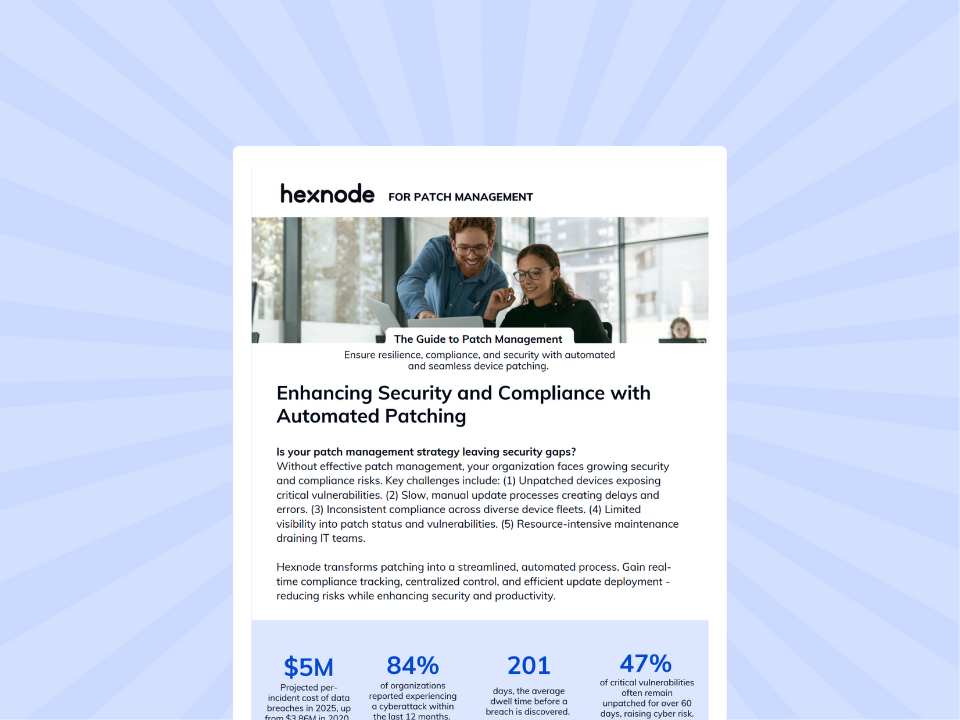
Featured Resource
Hexnode UEM for Patch Management
The Operational Challenges Behind the Risk
If patching is so critical, why do gaps persist?
Because in practice, patch management is complex.
1. Fragmented Visibility
Organizations often manage a mix of operating systems and applications across devices. Without centralized visibility, it becomes difficult to track which systems are updated and which are not.
2. Manual Decision-Making
Not all patches are equal. Some address critical vulnerabilities, while others deliver minor improvements. IT teams must evaluate updates before deployment, but manual review slows down response times.
3. Balancing Risk and Stability
Deploying patches immediately can introduce compatibility issues. Delaying them increases security risk. Striking the right balance is not straightforward.
4. Distributed Workforces
With remote and hybrid work now the norm, endpoints are no longer confined to a single network. Devices may be offline, on unstable connections, or outside traditional control boundaries.
5. User Behavior
Even when updates are available, users may:
- Ignore notifications
- Postpone restarts
- Interrupt installations
This introduces inconsistency – one of the biggest enemies of security.
A Security-First Approach to Patch Management with Hexnode
Hexnode approaches patch management as an extension of endpoint security not just device maintenance. Its capabilities are designed to give IT and security teams the control, visibility, and flexibility needed to reduce exposure without disrupting operations.
Unified Visibility Across Windows and macOS
One of the fundamental requirements of effective patch management is visibility.
Hexnode provides a centralized console to monitor and manage updates across devices, covering both operating system updates and application patches. This unified approach ensures that IT teams can track update availability and deployment status without switching between tools or workflows.
Controlled Deployment Through Approval Workflows
Blindly deploying every available patch can introduce risk. Not all updates are suitable for immediate rollout, especially in environments with critical systems or dependencies.
Hexnode allows administrators to:
- Review updates in detail
- Approve or reject patches before deployment
This ensures that patching remains intentional and controlled, rather than automatic and potentially disruptive.
Granular Targeting Based on Risk Criteria
Not every vulnerability requires the same level of urgency.
Hexnode enables IT teams to define deployment criteria using parameters such as:
- CVE identifiers
- KB numbers
- Severity levels
- Classification
- Release dates
This level of granularity allows organizations to:
- Prioritize high-risk vulnerabilities
- Focus on critical patches first
- Avoid unnecessary updates
The result is a more risk-aligned patching strategy, rather than a one-size-fits-all approach.
Automation Without Losing Governance
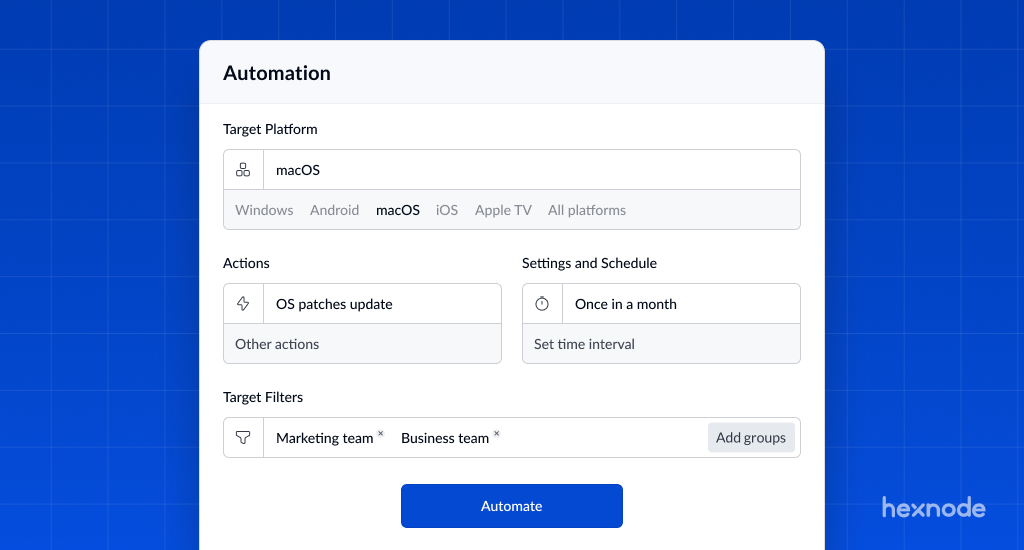
Hexnode supports automated patch deployment based on predefined conditions and device groups. This allows IT teams to:
- Roll out updates consistently
- Reduce manual intervention
- Maintain policy-driven control
Flexible Deployment and Maintenance Windows
One of the biggest barriers to timely patching is user disruption.
Hexnode addresses this by allowing administrators to configure:
- Deployment schedules
- Maintenance windows
- Active hours
Updates can be pushed during off-hours to minimize impact on productivity. Additionally, administrators can define:
- Deadlines for installation
- Grace periods for compliance
This flexibility ensures that patching aligns with both security priorities and operational realities.
User-Centric Restart and Notification Controls
Restarts are often the most disruptive part of patching and the most resisted by users.
Hexnode provides controls to:
- Notify users ahead of scheduled restarts
- Customize notification timing and messaging
- Allow limited postponement of restarts
By giving users visibility and a degree of control, organizations can improve compliance without enforcing abrupt interruptions.
Continuous Monitoring and Alerts
Patch deployment is not complete until it is verified.
Hexnode enables IT teams to:
- Track installation status across devices
- Identify failures or missed updates
- Receive alerts for issues requiring attention
This creates a closed-loop patch management process, where gaps can be quickly identified and addressed.
The table below maps key Hexnode features to their real-world security impact.
| Capability | What It Does | Security Impact |
| Centralized visibility | Tracks updates across devices | Eliminates blind spots |
| Approval workflows | Review patches before deployment | Reduces deployment risk |
| Granular targeting | Filter by CVE, severity, etc. | Prioritizes critical vulnerabilities |
| Automation | Schedules and enforces updates | Reduces patch delay |
| Maintenance windows | Controls deployment timing | Minimizes disruption |
| Monitoring & alerts | Tracks patch status | Ensures compliance |
A Strategic Imperative for Security Leaders
For organizations in regions with strong regulatory expectations such as GDPR compliance in the UK and Germany or evolving cybersecurity mandates in the US – patch management plays a critical role.
It supports:
- Audit readiness
- Risk reduction
- Endpoint security hygiene
More importantly, it reflects maturity.
Security leaders who treat patching as a core control not a background task are better positioned to prevent incidents rather than respond to them.
Because in most breaches, the root cause isn’t a lack of tools.
It’s a gap that was left unaddressed.
Take Control of Patch Management
Hexnode helps IT teams manage updates and automate patching across Windows and macOS from a single console.
Start Free Trial